Timeline
Dated stops, not a yearbook. The map changed more than once. Keep the stages separate. Dress across the same span is on wardrobe — imagined plates, not museum cases. The line itself is on borders.
The arc
Greek ports and a Dacian highland; a short Roman province; a Latin that stayed after the forts emptied. Then thin sources and movement. Three lands — Wallachia, Moldavia, Transylvania — not one court. 1859 put two principalities under one prince; 1878 made that state recognized; 1918 widened the map. The twentieth century cut it, occupied it, and ran a party state. After 1989 the chairs moved. NATO and the EU changed the frame, not the surveyor’s line.
Jump an era to open it. Enter or Space on an era heading does the same. The first era starts open.
Ancient & Roman to c. 271
-
6th century BCE – Tomis
Greek settlers from Miletus founded Tomis on the Black Sea coast — today’s Constanța. Grain, fish, and ships made the harbor matter before any later capital inland. Ovid was exiled here under Augustus; the place kept a Greek and then Roman face long after the inland kingdoms rose and fell. The port sat on a short salt shore, with steppe behind it, not on a Carpathian valley. That split is still how the coast is used: crane and promenade, then the holiday strip. The salt edge is still the short Romanian shore on the sea. See Constanța.
-
1st century BCE – early 2nd century CE — Getae and Dacians
North of the Danube, Geto-Dacian groups held the Carpathian basin and the hills beyond. Burebista briefly pulled a large kingdom together in the first century BCE; Decebalus faced Rome two centuries later from a fortified highland core. Those same slopes are still where people meet bear and wolf — see wildlife. Ancient writers often paired them with the Thracians south of the river. They were neighbors and kin in language and custom, not one court. See Thrace and Dacia.
What people wore. Field and house work sat in a short linen or wool tunic, a belt pouch, and cloth wrapped at the calf. Elite dress on the plate is a longer patterned coat, a dark cloak with a clasp, and a cap — rank in cloth and length. The drawing pairs garments, not kinds of people. All six plates: wardrobe.
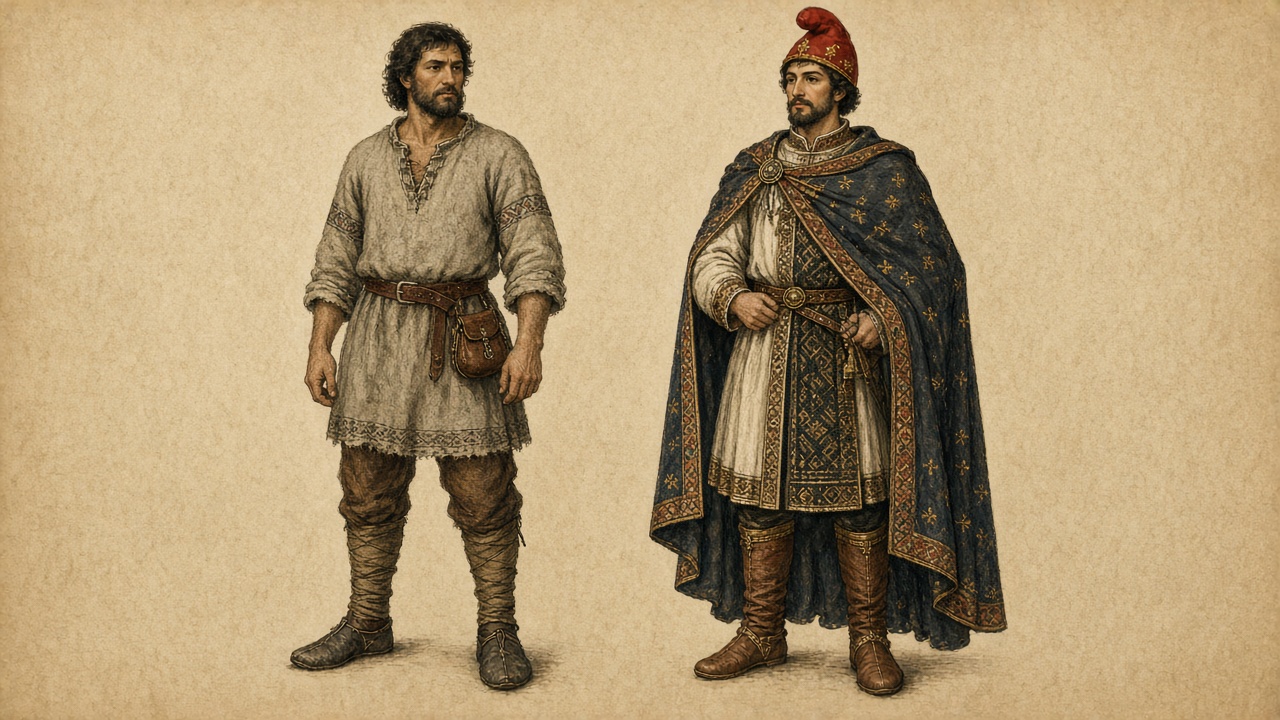
Imagined art — working and elite dress (schematic, not a museum reconstruction). -
101–106 — Trajan’s wars; province of Dacia
Rome conquered Dacia under Trajan after two hard campaigns. The highland capital at Sarmizegetusa fell in 106; a new colonial Sarmizegetusa was laid out in the Hațeg basin. The province sat north of the Danube for a relatively short time by imperial standards — roads, camps, and colonists pulled from other parts of the empire, then pressure from every side. Gold from Alburnus Maior (Roșia Montană) and salt moved on those roads; the forts did not last. Latin on stone is not the same as Latin in the yard. What stayed was not the administration. It was a Latin-based speech that outlived the legions — pâine from panis is still the loaf on bread. See The Latin that stayed.
-
c. 109 — Tropaeum Traiani
After the Dacian wars Rome raised a victory monument at Adamclisi, in the Dobruja hills behind the Greek coast. Tropaeum Traiani marked a battle against a mixed force on the lower Danube, not the fall of the highland capital. The stone sat on the same short salt shore as Tomis, looking inland at steppe, not at Sarmizegetusa. The later Romanian sea window is still that shore — see the sea and Constanța. The province north of the river was a different administration. This trophy belonged to the older Moesian edge that did not empty when Aurelian withdrew.
-
c. 271 — Roman withdrawal
Under Aurelian the empire pulled the formal province back south of the Danube. Forts emptied; some people moved with the army, others stayed. The end of the province is not the end of Latin speech in the region — only the end of Roman government north of the river. The river stayed a border in Roman minds long after the province was gone — that water is still the southern edge on rivers, and later a line on borders. Prefer that distinction to tidy origin myths.
Early medieval 4th–13th centuries
-
Late antiquity – early Middle Ages
After the legions, successive peoples moved through the lower Danube and the Carpathian arc: Goths, Huns, Avars, Slavs, and others whose names fill the chronicles more thickly than the villagers’. The First Bulgarian Empire pressed north of the river for a time; Pechenegs and Cumans followed on the plains. Written sources for the Romanian-speaking population in these centuries are thin. Slavonic left words and church practice; the Latin grammar held. The church that remained was the Eastern one — see Orthodoxy. The ridges that watched all of this are still the ones on north. Prefer that outline to invented detail.
-
Late 9th–10th centuries — Magyars and the basin
Magyar groups took the Carpathian basin in the late ninth century and built a kingdom that would claim the lands inside the mountain arc. That is the start of Hungary’s long hold on Transylvania, not the start of the Romanian-speaking villages already on those slopes. The ridges that watched it are still the ones on north. The three later lands were not yet courts — see three lands, not one court and borders.
-
10th–13th centuries — Vlachs in the sources
Byzantine, Hungarian, and other writers begin to name Vlachs — Romance speakers — in the Balkans and along the Carpathian rim. The notices are scattered and often hostile or brief. They mark a people already there when the later principalities take shape, not a sudden arrival with a foundation charter. Daily life still sat in yards and seasonal work more than in any court we can name; see the house and the loaf that meant the room was fed, on bread. Flocks still climb and come down on that older calendar — see shepherds.
-
12th–13th centuries — Saxons, Szeklers, the mountain counties
The Hungarian crown planted counties, invited German (Saxon) settlers into the towns, and settled Szeklers on the eastern edge. Salt, gold, and the pass roads made the bowl worth a charter. Romanian-speaking villages were already on the ground; they were not named as a political nation in those charters. A later diet would make that exclusion law. The wooden churches and the village yard belong to that uneven map — see wooden churches, villages, and north. The Mongol storm is the next blow.
-
1241–1242 — the Mongol storm
Mongol armies crossed the Carpathians, broke the Hungarian kingdom, and raided through the lower Danube lands. Towns and fields took the blow; the political map of the basin did not recover as it had been. The storm did not found Wallachia or Moldavia. It thinned the powers that had held the passes and the plains, and the later principalities grew in that thinner air. Hold the raid as a midpoint, not as a creation myth. The three lands that take shape in the next century are on borders and in the lesson three lands, not one court.
Principalities 14th–18th centuries
-
14th century — Wallachia and Moldavia
South of the mountains, Wallachia gathers under early Basarab princes; to the east, Moldavia takes shape in the same century. These are frontier principalities between larger empires, not modern nation-states. Tribute, church endowment, and switching protectors were the ordinary tools of survival. Monasteries kept the books when the state was small; that habit is on Orthodoxy. The three lands stayed separate for a long time — the line is on borders. See Three lands, not one court.
What people wore. Village work kept the ia — the embroidered blouse — with a dark apron and a head cloth. The stitch is regional; see crafts. Boyar dress on the plate is a long patterned caftan and a fur hat. Same lands, different cloth and length.
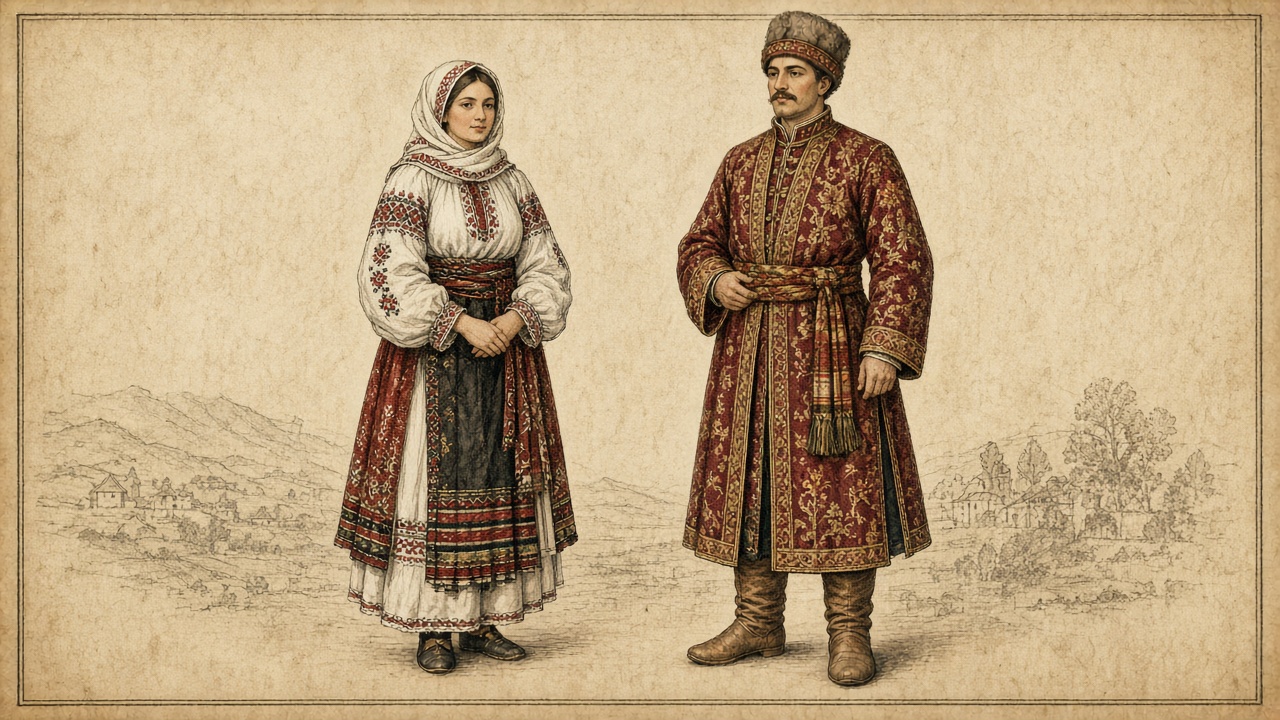
Imagined art — working and elite dress (schematic, not a museum reconstruction). -
Late 14th – 15th century — Wallachia between empires
While Moldavia’s later century is often told through one prince, Wallachia spent these decades between the Ottomans, Hungary, and its own boyars. Mircea cel Bătrân (c. 1386–1418) fought at Nicopolis, held the Danube line for a time, and paid tribute when he had to — a frontier bargain, not a modern border. Vlad Țepeș’s short reigns in the mid-fifteenth century used terror against boyars and Ottoman pressure alike. Later tourist Dracula is a different story; keep it off this stop. The river he watched is still the southern edge on rivers. The three lands were not one court — see three lands and borders.
-
14th–16th centuries — Transylvania
Inside the Carpathian arc, Transylvania sat under the Hungarian crown, with Hungarian nobles, Saxon towns, and Romanian-speaking villages sharing an uneven legal map. After the peasant rising of 1437–38, the Unio Trium Nationum named three estates — nobles, Saxons, Szeklers — and left Romanian speakers outside that legal nation. After Mohács (1526) — the next stop — the region entered the Habsburg and Ottoman contest as a principality with its own estates. Romanian speakers were many on the ground and late to political voice. A Transylvanian sat could sit under a different law than the Hungarian town or the Saxon street at the end of the same valley — see villages. The northern valleys of that bowl are on north. The three lands stayed separate — see borders.
-
1457–1504 — Ștefan cel Mare
Stephen the Great ruled Moldavia for nearly half a century, fought the Ottomans and neighbors, and left a string of churches. The painted exterior walls of northern Moldavia belong to this world of defense and display — a claim on the ridge as much as a prayer. See Why the walls are painted, the ridges on north, and a short portrait on men.
-
16th century — after Ștefan; Petru Rareș
Stephen’s Moldavia did not vanish in 1504. Petru Rareș, his illegitimate son, ruled in two stretches and kept endowing the painted north — Humor, Moldovița, and the ridge churches that still argue with the weather. Ottoman pressure thickened; the painted exterior was still defense and display. See why the walls are painted and north. Wallachia in the same decades stayed between empires; that earlier stop still holds. Mohács, next, remade the Hungarian world those princes had to live beside.
-
1526 — Mohács
The Hungarian kingdom broke on the field at Mohács. What followed in Transylvania was a principality in the Habsburg–Ottoman contest, with its own estates — the Unio Trium Nationum already named, Romanian speakers still outside that legal nation. Wallachia and Moldavia remained separate tributary courts. One battle did not make one country. The three lands stayed three — see borders and three lands.
-
1600 — Mihai Viteazul
Michael the Brave briefly held Wallachia, Transylvania, and Moldavia under one person. It was a personal union in a crisis of Habsburgs, Ottomans, and local estates — not a lasting national state. The three lands went their ways again after his death in 1601. Later schoolbooks read the year as a sketch of one country; hold both the myth and the short fact. See men and the later line on borders.
-
17th century — Matei Basarab and Vasile Lupu
After 1601 the lands were separate again. Matei Basarab in Wallachia (1632–1654) and Vasile Lupu in Moldavia (1634–1653) built churches, printed books, and fought each other as often as they fought the Ottomans. Printing and a written Romanian in church and law belong to these courts as much as to later national schools. It was rivalry and endowment, not a second union. Monasteries still kept more memory than the chancery — see Orthodoxy. Dress at these courts is the caftan plate on wardrobe, not a new fashion of its own. Brâncoveanu is the next Wallachian court.
-
1688–1714 — Constantin Brâncoveanu
In Wallachia, Constantin Brâncoveanu held a long reign: churches in a carved, light style later called Brâncovenesc, printing, and a court that bargained with Ottomans, Habsburgs, and Russians. In 1714 he and his sons were executed in Constantinople. The style stayed in stone; the room to bargain did not. Phanariot appointments harden after this generation. Monasteries and the yard still kept more memory than the next court — see Orthodoxy and the house. Dress at these courts is still the caftan plate on wardrobe.
-
1711 — Cantemir and Stănilești
Dimitrie Cantemir of Moldavia sided with Peter the Great; the campaign died at Stănilești on the Prut. Cantemir left for Russia and wrote the land down — Descriptio Moldaviae — a scholar’s map, not a lasting alliance. After the failed turn, the Porte tightened the appointment of princes. The Phanariot decades that follow are that tightening, not a sudden Greek fashion. The river of that defeat is still a line on rivers and later on borders.
-
Late 17th – 18th century — Transylvania under the Habsburgs
After the Ottoman retreat, Transylvania passed under the Habsburg court. The diet still privileged Hungarians, Saxons, and Szeklers. A union with Rome was offered to some Romanian communities at the end of the seventeenth century; many stayed Orthodox — that split is on Orthodoxy. In 1784 a peasant rising under Horea, Cloșca, and Crișan burned through the Apuseni. The villages did not gain a political nation. They gained a longer argument with Vienna and with the estates above them. Bukovina passed to the same court in 1775 — an earlier cut, remembered when 1918 looks like a sudden widening. The painted ridges of that northern strip are on north. See borders.
-
18th – early 19th century — Phanariot decades
In Wallachia and Moldavia, Ottoman-appointed Phanariot princes from the Greek elite of Constantinople ran the courts for much of the eighteenth century and into the nineteenth. Offices were bought, taxes pressed hard, and reform talk grew alongside foreign pressure from Russia and the West. Greek remained a court language for a time; Romanian print and school talk were already pushing back from below. The old tribute arrangement was wearing out; boyars and towns wanted a different kind of prince. The yard and the mill still ran on an older clock than the court — see the house and bread.
19th century 1812–1913
-
1812 — Bessarabia to Russia
The Treaty of Bucharest, at the end of another Russo-Turkish war, cut Moldavia at the Prut. The eastern half — Bessarabia — passed to the Russian empire. Bukovina had already gone to the Habsburgs in 1775. Hold both cuts when 1918 looks like a sudden widening. It was also a gathering of pieces already taken. The line of that river is on rivers and borders. Across the Prut the other Romanian-speaking state is still a later fact — see the present stop, and north for the painted strip that stayed Habsburg.
-
1821 — Tudor Vladimirescu
Tudor Vladimirescu raised a popular rising in Wallachia against Phanariot rule and local abuse, in the same year as the Greek struggle against the Ottomans. His movement mixed social anger with politics and ended in his death. It did not create a free state, but it marked that the old court order was cracking in public, not only in petitions. The Phanariot line in Wallachia ended soon after; Ottoman suzerainty did not.
-
1831–1832 — Organic Regulations
After the Russo-Turkish war of 1828–29, Russian occupation left both principalities a written statute: the Regulamentele Organice. Same model in Wallachia and in Moldavia — assemblies, a prince, a budget, a quarantine line. It was a protectorate document, not independence, and it still sat under Ottoman suzerainty. What it did was make the two administrations look enough alike that a later double election could work. The union lesson starts in 1859 on purpose; this is the paperwork underneath. See How the country was put together and borders.
-
1848 — revolutions
Wallachia, Moldavia, and Transylvania each felt the European year of revolutions in their own key: language, land, and who spoke in public. In Wallachia a short provisional government rose and fell; Ana Ipătescu is one of the few women named in that street story — see women. In Transylvania the Romanian petition for rights sat inside a wider Hungarian and imperial crisis. At Blaj that spring a large gathering asked for language and land in public, and still had to live under the old estates when the year closed. The maps did not rewrite overnight.
-
1856 — Paris, after the Crimean War
The Crimean War ended with a European settlement that pulled the principalities out of the tightest Russian protectorate and put them under the guarantee of the powers. The Treaty of Paris (1856) and the congress that followed made a double election conceivable. It was not independence, and it was not union. It was the diplomatic room in which 1859 could happen. Southern Bessarabia’s districts were shuffled in that same settlement — a small return, not the 1812 cut undone. See How the country was put together and borders.
-
1859 — Cuza and the United Principalities
Wallachia and Moldavia elected the same prince, Alexandru Ioan Cuza. That double election is the start of the modern state — one administration assembled from two. Land, schools, and a civil code followed in 1864 — that stop. Boyar patience did not. Cuza was forced out in 1866 — the next stop. Transylvania was not in the bargain. Elena Cuza’s charity work belongs to the same years — see men and women, How the country was put together, and the stages on borders.
-
1864 — Cuza’s reforms
The double election was four years old when Cuza pushed through the hard laws: secularization of monastic estates, a rural law that tried to break the worst of the corvée, a civil code, and schools that were supposed to reach past the boyar house. He did it by coup against his own assembly. The villages got a plot and a new kind of paper; they did not get a fat year. Boyar patience ran out two years later. Elena Cuza’s charity work belongs to the same stretch — see women. The union lesson keeps the election and the reforms in one reign; this stop is the paperwork. See men and How the country was put together.
-
1866 — a constitution and a foreign prince
After Cuza’s fall the political class brought in Carol of Hohenzollern-Sigmaringen and passed a constitution modeled on Belgium’s. A foreign prince was meant to make the new state look permanent to the courts of Europe. The 1866 constitution lasted, with patches, into the next century: a limited franchise, a strong crown, and a still-rural country that now had a European address. Independence was not yet recognized. That fight is the next war. The line of the two principalities is still the one on borders.
-
1867 — Ausgleich; Transylvania into Hungary
The Habsburg empire split into a dual monarchy. Transylvania, which had had its own diet in uneasy seasons, was drawn fully into the Hungarian half. Romanian speakers there had parties, school fights, and later a memorandum. They did not have the state. 1859 had not included them; 1867 made the wait longer and the argument sharper. The villages of that bowl are on villages; the northern wood and hay on north. 1918 is the later hinge, not this one. See How the country was put together and borders.
-
1877–1878 — the independence war
Romania entered the war against the Ottomans beside Russia and declared independence in May 1877. Romanian troops fought hard at Plevna and later at Grivița and Smârdan — a short, costly campaign, not a parade. The treaties that followed, San Stefano and then Berlin, made the state recognized. Northern Dobruja, and with it Constanța, came in that settlement — a sea window the principalities had not held. See the sea, Constanța, and the line on borders.
-
1881–1914 — Carol I and the kingdom
Carol of Hohenzollern, already prince since 1866, became king Carol I in 1881. He reigned a long time: railways, a constitution, a still-rural country, and a court that wanted to look European. Grain left on those rails; the loaf at home was still the village oven’s — see bread. The villages kept their own year — harvest, winter, the ia. A European dynasty sat on a kingdom whose map still stopped short of Transylvania. The 1907 rising in the next stop is the crack in that picture.
What people wore. A village man in this century still wore an embroidered shirt, a vest, and wrapping at the calf. Urban elite women wore a fitted European gown. The gap is work and city fashion. The shirt’s stitch is the same craft as the ia on crafts.
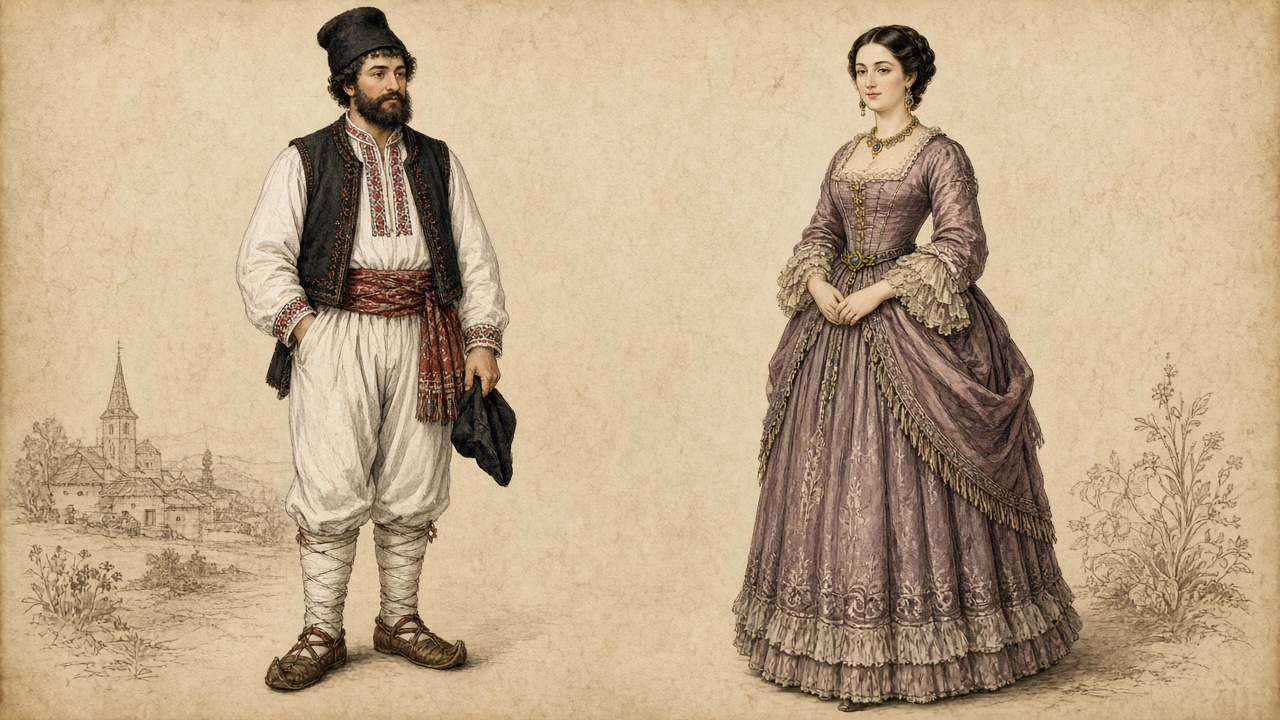
Imagined art — working and elite dress (schematic, not a museum reconstruction). -
1907 — the peasant revolt
In the spring of 1907, land hunger broke into revolt, first in Moldavia and then across Wallachia. Estates, leaseholders, and the army met a countryside that still lived by the harvest and the loaf on bread, while the export grain moved on Carol’s railways. The repression was hard; thousands died. The kingdom that looked European from Bucharest had not settled the land. Reform talk followed. The structure of large estates and a thin village plot did not vanish. See villages.
-
1912–1913 — Balkan Wars
Romania stayed out of the First Balkan War, then entered the Second and gained southern Dobruja — the Cadrilater — at the expense of Bulgaria. A short campaign on the country’s southern edge, before the much larger war that would remake the whole map. The strip was grain land and a contested minority map, not an empty field. It was argued from the start; it would go back to Bulgaria in 1940. The older sea window, northern Dobruja and Constanța, stayed — see the sea and the line on borders.
Greater Romania & interwar 1914–1939
-
1914–1918 — Ferdinand, Marie, and the war
Ferdinand succeeded Carol I in 1914. Romania entered the First World War late, on the Allied side, was occupied in the south, and the court and army fell back to Moldavia. Then the country found itself among the winners as Austria-Hungary came apart. Queen Marie worked in hospitals and spoke for the Allied cause. Villages emptied toward the front — Ecaterina Teodoroiu is one name from that emptying. Both sit on women. The map that followed is the next stop. The northern ridges that came in with Bukovina are on north.
-
1918 — Greater Romania
After the First World War, as the old empires broke, assemblies in Bessarabia, Bukovina, and Transylvania voted union with the kingdom. The enlarged map is what people later called Greater Romania. It included many who were not Romanian speakers. Bucovina’s painted ridges are on north; the line that widened, then later shrank, is on borders. Queen Marie’s wartime and diplomatic work sits in that story — see women and A century, read slowly.
-
1919–1920 — the treaties
The assemblies of 1918 voted union; the diplomats spent the next years arguing the edges. Saint-Germain, Trianon, and the Paris settlement of 1920 gave Greater Romania a legal outline other capitals had to swallow. It was not a map everyone accepted. Hungarians in Transylvania, Germans, Jews, Ukrainians, and others woke up inside a new kingdom. A union voted in a crisis is not the same as a settlement everyone signed in the same ink. Queen Marie’s diplomatic work sits in that story — see women. The line that widened is on borders; the century that had to govern it is on a century, read slowly.
-
1918–1939 — interwar
A large new kingdom tried to govern lands that had never shared one law. Land reform, parties, and the 1923 constitution that promised more than local power delivered. Schools and railways spread; minorities and borders stayed contested — see borders. Constanța’s harbor grew with the enlarged state — see the sea. The 1930s slid toward authoritarianism. In 1938 King Carol II buried the party system and ruled by royal dictatorship, with the Iron Guard as a violent rival on the far right. Bucharest was the capital; Cluj, Chișinău, Cernăuți, and the Saxon towns had other memories. Cernăuți’s Bukovina is the northern edge on north.
What people wore. Workshop and field clothes stayed a shirt, vest, sash, and a heavy shoe. City elite women wore a long tailored coat, gloves, and a small hat, sometimes with an embroidered band that still points to the ia on crafts.
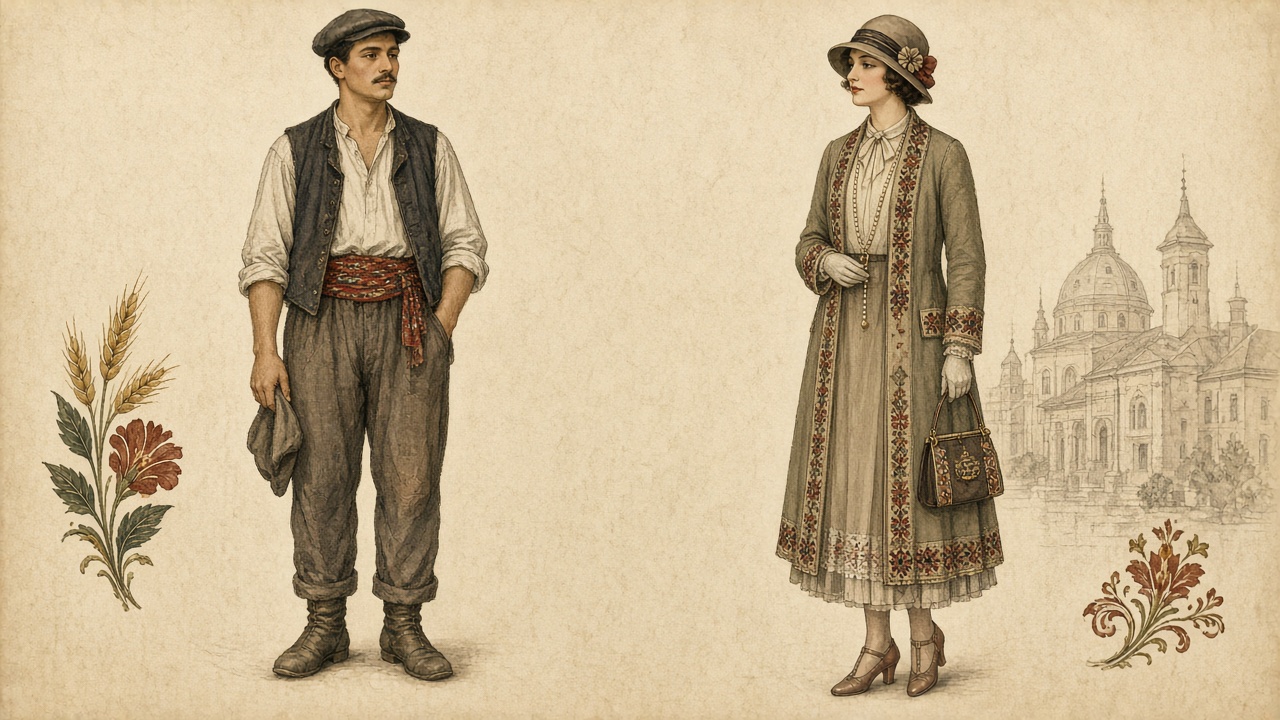
Imagined art — working and elite dress (schematic, not a museum reconstruction).
WWII & communism 1940–1989
-
1940–1944 — Antonescu and the war
In 1940 Romania lost territory to the Soviet Union, Hungary, and Bulgaria — the cuts are on borders. Those losses broke the Carol II regime. Ion Antonescu took power with the Iron Guard and then against it, and allied with Germany. Romanian armies went into the Soviet Union. The state took part in the murder and deportation of Jews and Roma, especially in Bessarabia, Bukovina, and Transnistria. In August 1944, with Soviet armies already on the soil, the country turned against Germany. Keep the alliance, the crimes, and the late switch in the same short frame — none of them cancel the others.
-
1944–1947 — end of the kingdom
King Michael’s coup of 23 August 1944 had broken with Germany; Soviet occupation and a coerced political order closed in anyway. Petru Groza’s government in 1945, and elections the next year that were not free, did the rest. The Paris peace of 1947 fixed the outer line: northern Transylvania stayed; Bessarabia and northern Bukovina did not. By the end of 1947 the king was forced to abdicate and a communist republic stood in the kingdom’s place. The peace left a smaller country than 1918 — that outer line is on borders. The crown’s century was over. What people wore in the next decades is the mid-century plate on wardrobe.
-
1948–1965 — party state and collectivization
Arrests, forced collectivization of the land, and the Canal. Gheorghiu-Dej ran a party state that watched stairwells and workplaces. Grain and yards were pulled into the plan; the older harvest calendar did not vanish, but the state’s claim tried to outrank it. The mill and the loaf became a quota as much as a household — see bread. Industry was the promise. Fear was the method. The road still filled on a feast day; much of the week it answered to the collective — see villages.
-
1965–1989 — Ceaușescu
Nicolae Ceaușescu took the party in 1965. A brief opening — the 1968 refusal to join the Prague invasion — then the July Theses, a personality cult, and shortage dressed as a national road. Systematization tried to erase villages into agro-towns; many yards survived anyway. The Securitate watched the stairwell. The 1980s meant rationed heat and light, food exported to pay debt, and queues that taught a generation to wait — including the queue for the loaf on bread. Village yards emptied toward the block — the older house did not vanish, but the state’s plan tried to outrank it. Winter in those years was a dark stair and a cold flat as much as snow in the yard — see winter.
What people wore. Rural and factory weeks meant a plain dress or a wool jacket — clothes for the shift and the queue. City and office dress on the plate is a dark suit. The woven scarf is household cloth; the stitch is still the one named on crafts.
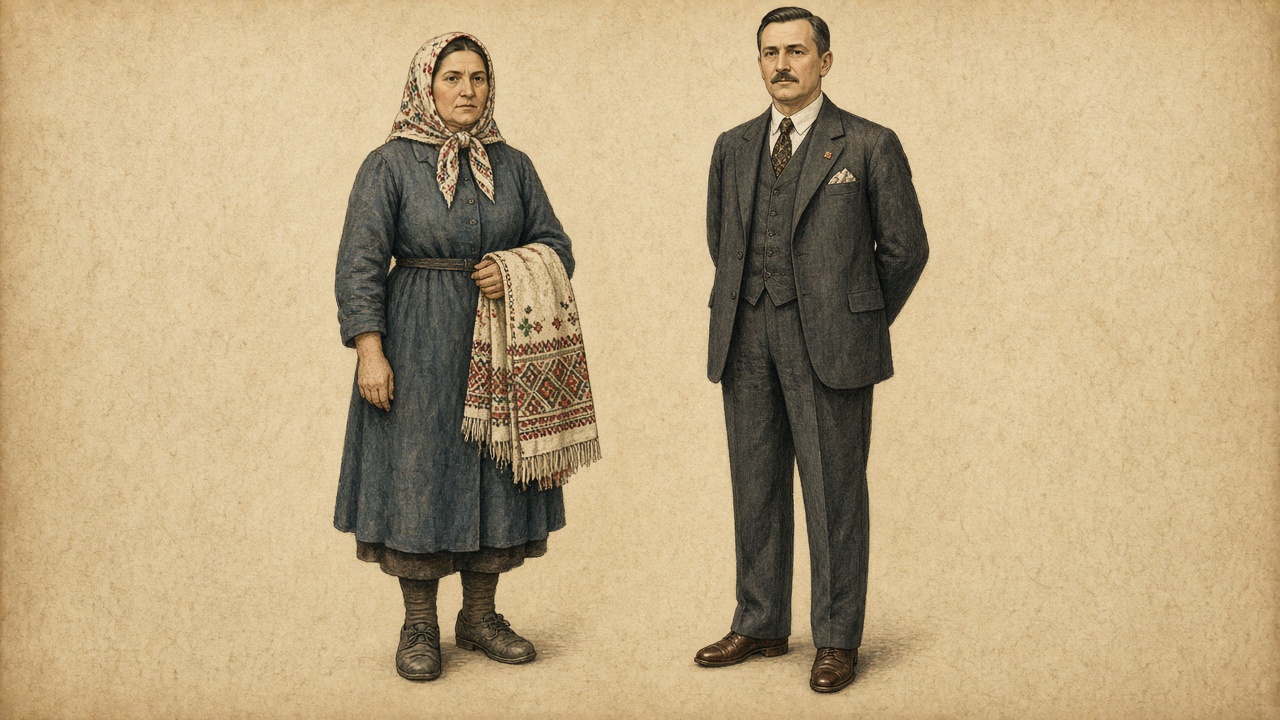
Imagined art — working and elite dress (schematic, not a museum reconstruction).
1989–present from December 1989
-
December 1989 — Revolution
The rising began in Timișoara and reached Bucharest within days. Ceaușescu and his wife fled, were caught, tried in haste, and shot. Crowds in the square, shooting whose chain of command is still argued, and a National Salvation Front that filled the empty chairs. What followed was a rough exit, not a clean door into another kind of country. The surveyor’s line did not jump — see borders.
-
1990–1991 — miners, constitution, the first unpacking
A new constitution in 1991 framed a republic after the old party state. Before and after that paper, the early years were noisy: the mineriade, miners brought into Bucharest in 1990, street politics, and property claims that did not land cleanly. Privatization was incomplete. Emigration began in earnest — locked village gates, money sent home, the ordinary fact on villages. Applications toward NATO and the EU started here, before the accession dates. Whether an election could empty a palace without a street war is the 1996 stop. The decade was less a triumph than a long unpacking of what the previous forty years had locked down.
-
1996 — the chairs move
A peaceful change of government showed the republic’s chairs could move without miners in the capital. The 1991 constitution had framed the paper; this year tested the door. Privatization was still incomplete; emigration was already a household fact — see villages. Applications toward NATO and the EU were the outbound path, not yet the dates. The unpacking of the previous forty years did not end here. It only proved the chairs could move.
-
2004–2007 — NATO and the EU
Romania joined NATO in 2004 and the European Union in 2007, in the same intake as Bulgaria, after years of negotiation against the union’s entry rules. Those dates close a long outbound path from the wartime and communist maps. Membership did not end politics or departure for work abroad; once the labor market opened, more people left, and more sent money back. It changed the frame in which both happen. The surveyor’s line on borders did not jump. The Black Sea window stayed the short shore on the sea.
-
Present
Ordinary EU membership, emigration and return, and arguments that still run through language, region, and memory. From 2022 the war in Ukraine sat on the northern and eastern edge as a neighbor fact, not a distant news item. Air and sea Schengen came in 2024; land borders followed in 2025 — a frame change, not a new map. Across the Prut, the Republic of Moldova is the other Romanian-speaking state; the surveyor’s line between them is the one on borders. The same ridges that outlasted every map on this page are still there — see north. Dated stops end; the ground does not. The loaf on the table is still a fair question — see bread.
What people wore. Everyday dress is a jacket, jeans, and boots. Festival and family days still bring out the ia — the embroidered blouse on crafts — worn with modern trousers. The mix is ordinary. All six plates: wardrobe.
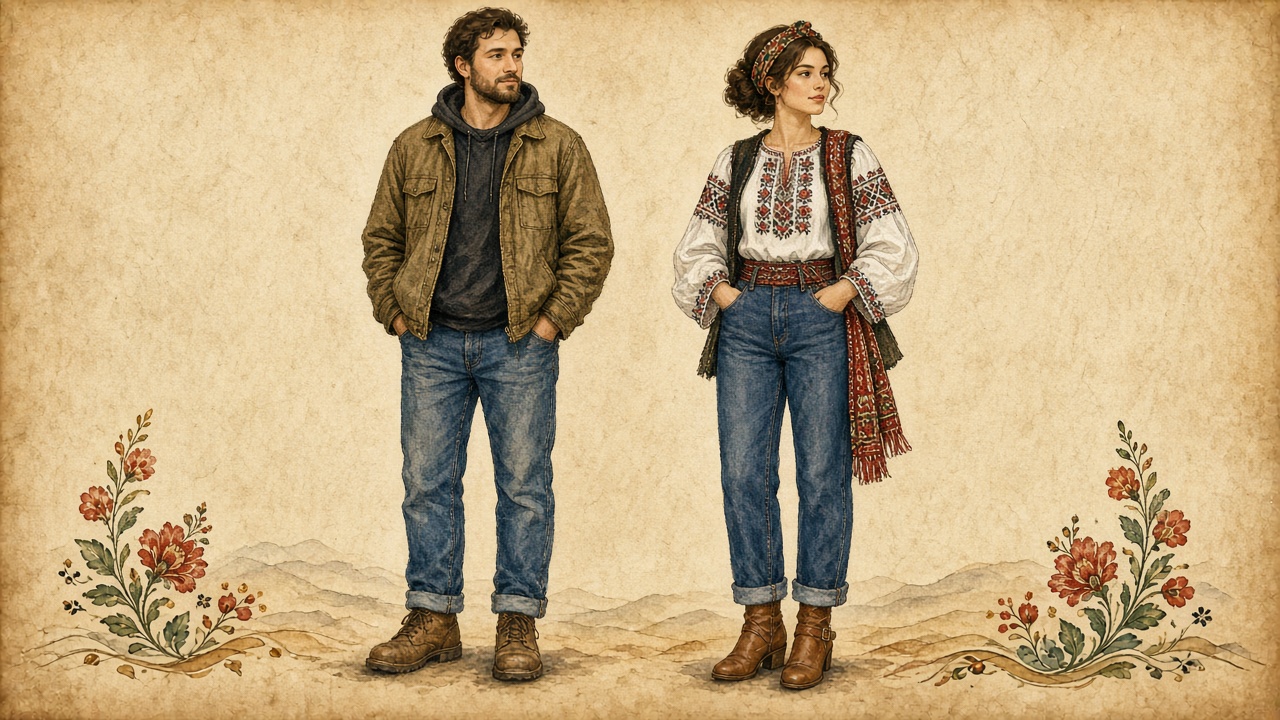
Imagined art — working and elite dress (schematic, not a museum reconstruction).