
Children’s games
What gets played in the yard and on the asphalt when nobody has brought a ball. Names change a little by county. The shapes of the games do not.
When it starts
After school, before the lamp. On a Sunday when the adults sit. In August when the village fills again and cousins appear who do not know this yard’s version of the count. Winter shortens the outdoor list; a slide of packed snow or a room game takes the rest. The names shift a little by county, and the children still know which one they mean. The road those yards share is on villages.
Șotron
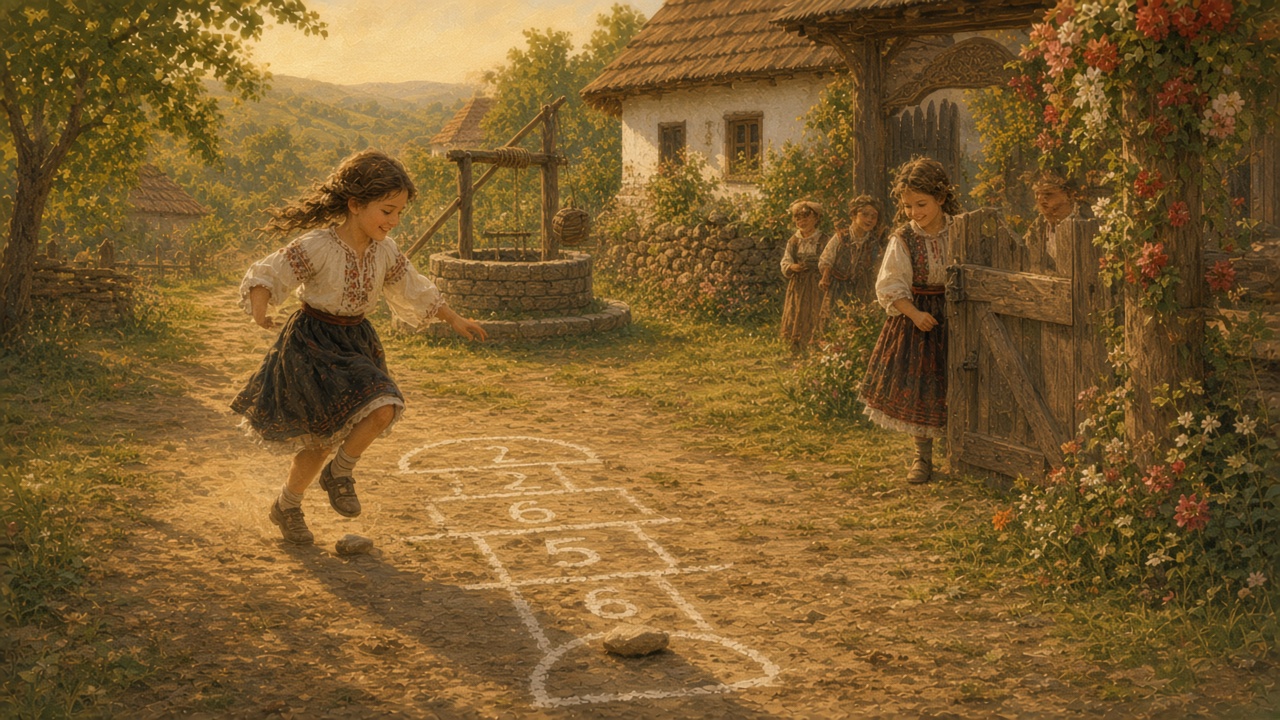
Hopscotch. Chalk or a stick in the dust draws the boxes, numbered, usually ending in a half-circle people call the heaven or the house. You throw a flat stone, hop on one foot, and pick the stone up without putting the other foot down. If you land on a line or on both feet where you should not, you are out of that turn. Girls keep this one longer than boys in a lot of towns. The pattern on the ground is the same game your grandmother would recognize, even when the chalk is pink.
De-a v-ați ascunselea
Hide and seek. One counts against a wall or a gate post, eyes covered, and the rest scatter into the yard, behind the woodpile, under the porch, into a shed that smells of onions. The call at the end of the count is the long one: “Unu, doi, trei… cine nu e gata, îl iau cu lopata.” When the seeker finds someone, they race back to the counting place and touch it. The last one found, or the one caught out in the open, counts next. In a village yard this can run until the light goes. In a block courtyard it runs until a parent opens a window.
De-a baba oarbă
Blind man’s buff. A scarf over the eyes, spun once or twice, and then the blind one has to catch someone by touch and say who it is. The others clap, duck, and pull at sleeves. It is louder than hide and seek and shorter, because someone always laughs and gives the game away. Indoors on a rainy afternoon it fills a room. Outdoors the blind one walks into the fence and the game stops for a minute of apology.
Elasticul
Two hold a long loop of elastic around their ankles, then their knees, then higher. The third jumps in patterns: in, out, on the band, a turn. Miss and you take a holding place. This is almost always girls, almost always after school, and it needs almost nothing but the band and a strip of pavement. The chants that go with the jumps differ by neighborhood. The height ladder does not.
Țară, țară, vrem ostași
Two captains, two lines, a call across the gap: “Țară, țară, vrem ostași.” “Ce ostași vreți?” A name is chosen, that child runs and tries to break the linked arms of the other team. If the chain holds, the runner joins that side. If it breaks, they take someone back. It is a recruiting game dressed as a war game, and it needs a wide enough street or a schoolyard. Adults who watch it usually remember their own captain more clearly than the rules.
Play in the browser
Short approximations of the five yard games above. They are not physics sims and not the real street rules — just enough to feel the shape of each one.
Șotron Hide and seek Baba oarbă Elasticul Țară țară
What else turns up
Marbles, bile, in a dirt circle. Leapfrog, and the piled game where one is the horse and the others vault. A skipping rope when someone has one. In winter, a slide of packed snow down a slope behind the house. None of this needs a kit from a shop. The yard in the house is already the board: gate, woodpile, porch, and a stretch of ground hard enough to chalk.