
Wardrobe
Working clothes and elite or city clothes, drawn as pairs across eras. A field tunic beside a cloak, an ia beside a caftan, a work dress beside a suit. A wardrobe, not a costume catalog. The dated stops live on the timeline.
Dacia and the early centuries
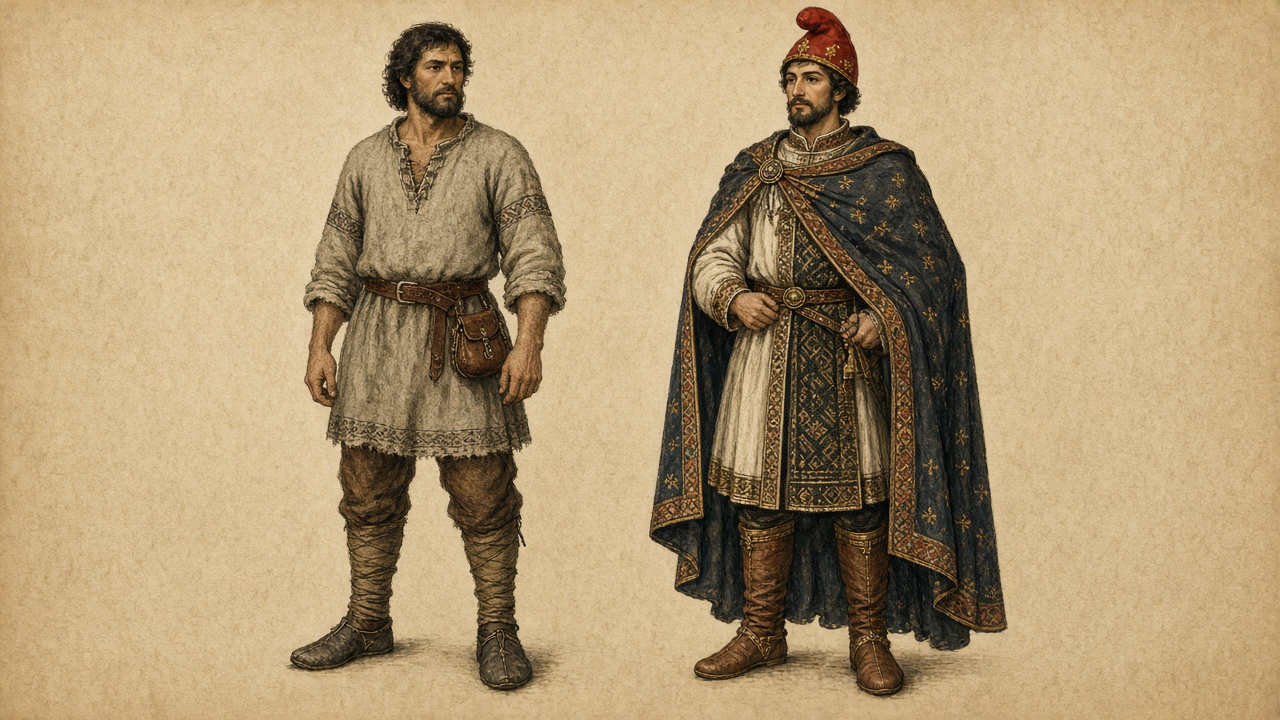
Field and house work sat in a short tunic of linen or wool, a belt pouch, and cloth wrapped at the calf. The cloth is undyed and short enough to walk and bend. Rank on the same plate is a longer patterned coat, a dark cloak closed with a clasp, and a cap. Length, a dyed edge, and a cloak you do not work in are what the drawing uses for rank.
Writers of those centuries left more about kings and wars than about a weekday shirt. The campaigns, the highland forts, and the short life of the Roman province are on the timeline. This plate keeps the split that every later pair repeats: cloth you can work in, and cloth that sets a person apart from the work.
The principalities
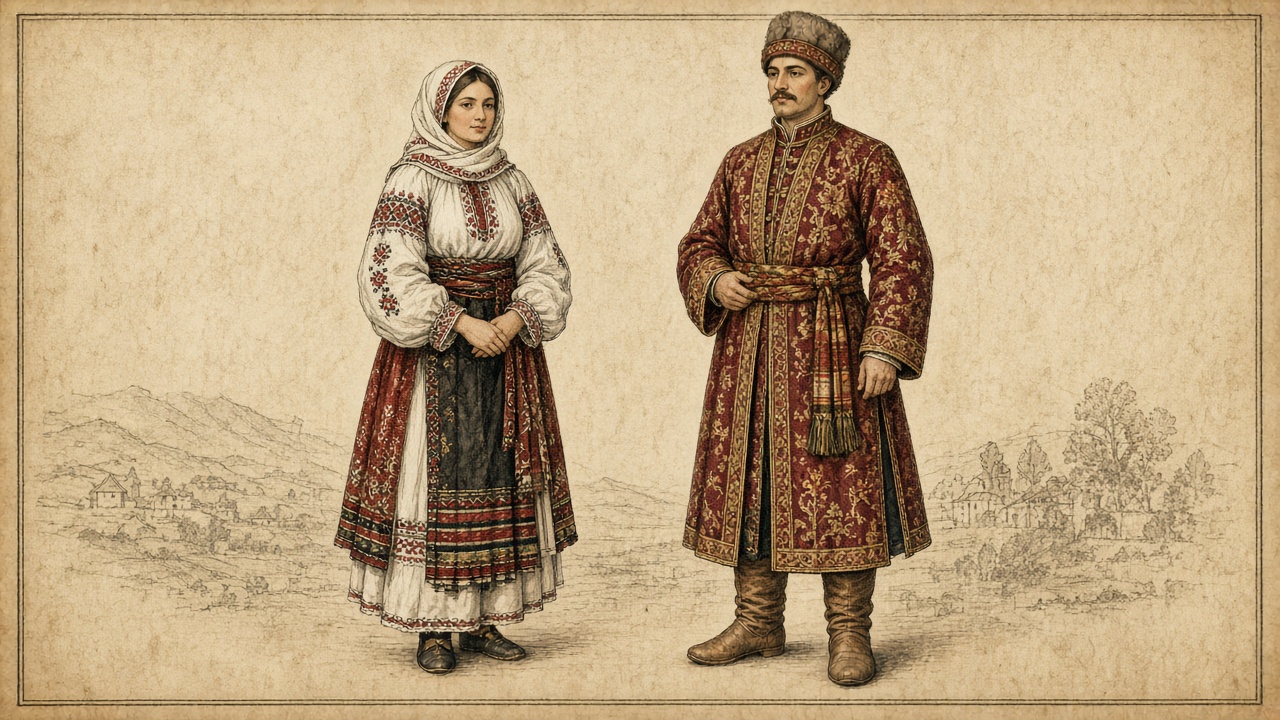
Village work kept a white blouse, a dark apron, and a head cloth. The blouse is the ia — the embroidered shirt named on crafts. Hemp or linen for the body of the cloth, stitch at the neck, the cuff, and the front. Sleeve and color mark a region more reliably than a border. Beside that, boyar dress is a caftan, a long patterned coat, and a fur hat. Fur and length mark rank.
The stitch was house work. It lived in the same rooms as the stove and the towel on the icon; that room is on the house. The courts that wore the long coat are named on men. The plate is the working blouse beside the coat of rank. Those centuries are on the timeline.
Union and the kingdom
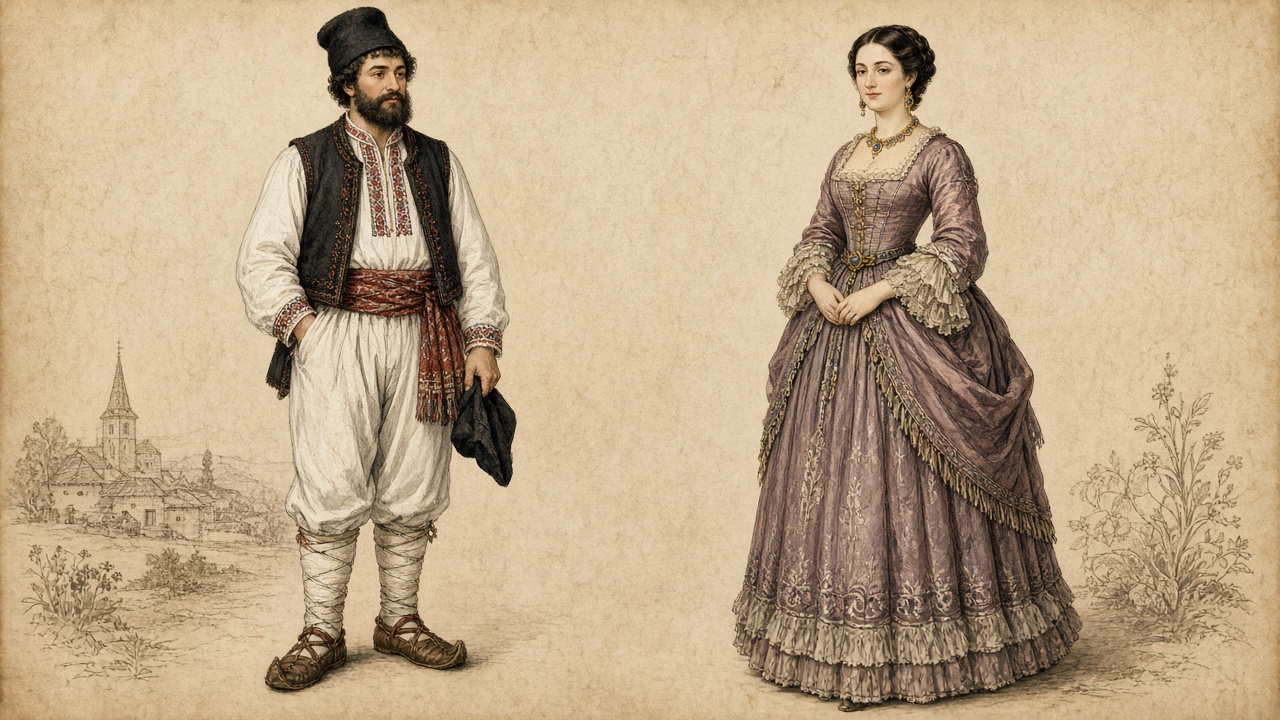
After the 1859 union a village man still went to the field in an embroidered shirt, a black vest, and cloth wrapped at the calf. The shirt is the same craft as the ia. The vest and the wraps are the work layer: something you can wash, a calf you rewrap when the mud is high. City dress in the same decades is a fitted European gown, cut to a waist, meant for a room with a floor. The new court wanted that European address. The villages kept the shirt.
The double election and the kingdom years are on the timeline. Cuza is on men. Elena Cuza’s charity in the same few years is on women. The gap on the plate is plainer than those names. One figure is dressed for the field. The other is dressed for a capital learning a new cut.
The interwar kingdom
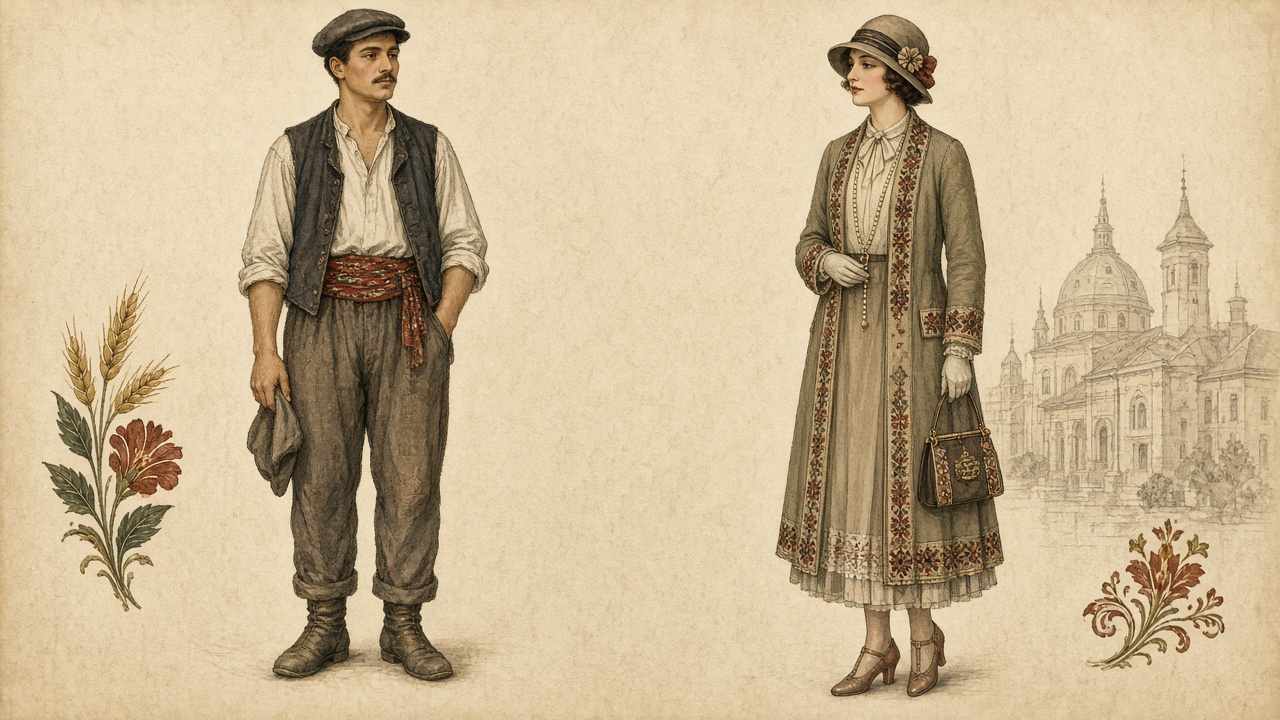
After 1918 the kingdom was larger, and the street mixed more kinds of cloth. Workshop and field clothes stayed a shirt, a vest, a sash — a brâu — and a flat cap, with a heavy shoe under them. City dress on the plate is a long tailored coat, gloves, a cloche hat, and a small bag. An embroidered band on the coat still points at the ia. The stitch has moved onto a city sleeve. It is no longer the whole outfit.
Queen Marie was the public face of that court. Her wartime and diplomatic years are on women. A wedding could still put the embroidered blouse in a yard while Bucharest wore the coat and the hat. Land reform, the 1923 constitution, and the harder 1930s are on the timeline. The plate keeps the two wardrobes that used the same pavement.
The communist decades
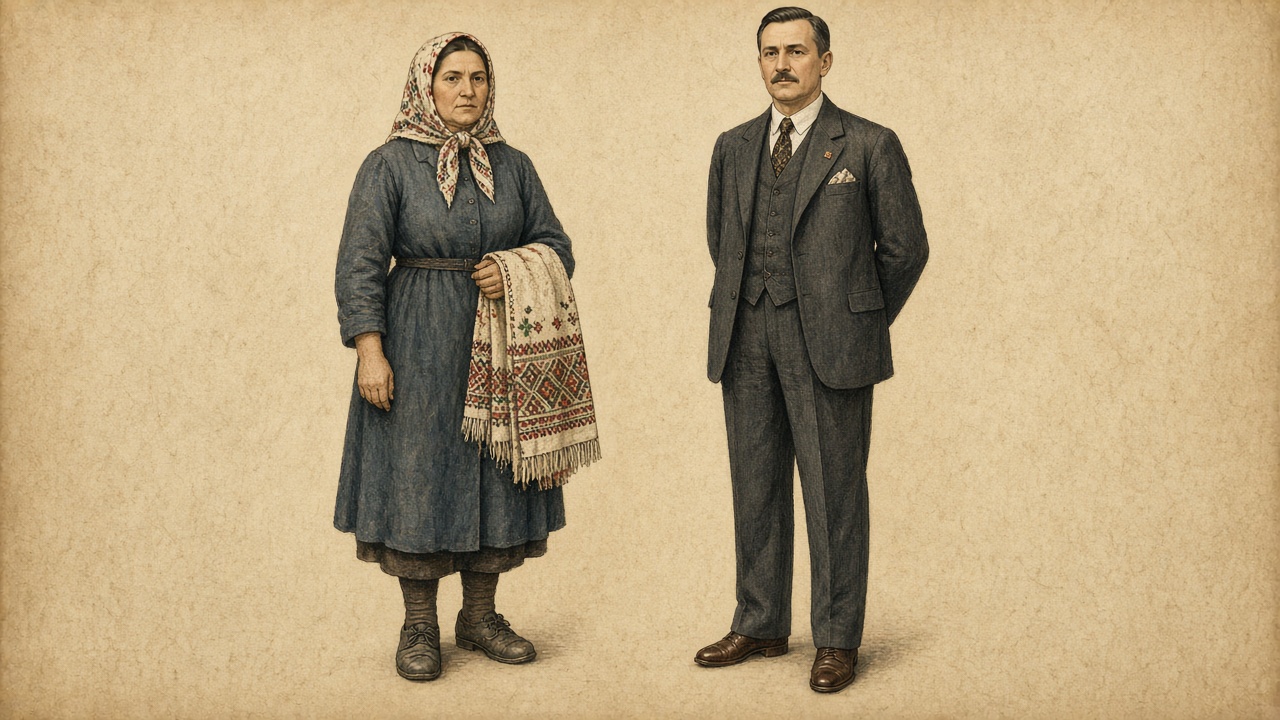
A plain dress, a wool layer when the stair was cold, and a patterned headscarf: that was the week in a village or on a factory shift. The blue dress on the plate is that work cloth. The woven towel in the hand is a ștergar, household cloth, the piece that still hangs at an icon corner on the house. Its stitch is the one named on crafts. The dark three-piece suit is the other side: the office, the meeting, the photograph.
Queues, the plan, and the move toward the block are on the timeline. Most days the body wore the dress or the jacket you could stand in for a shift. The suit was what you put on when the week asked for a public face. The pair is still work beside that cloth.
The present
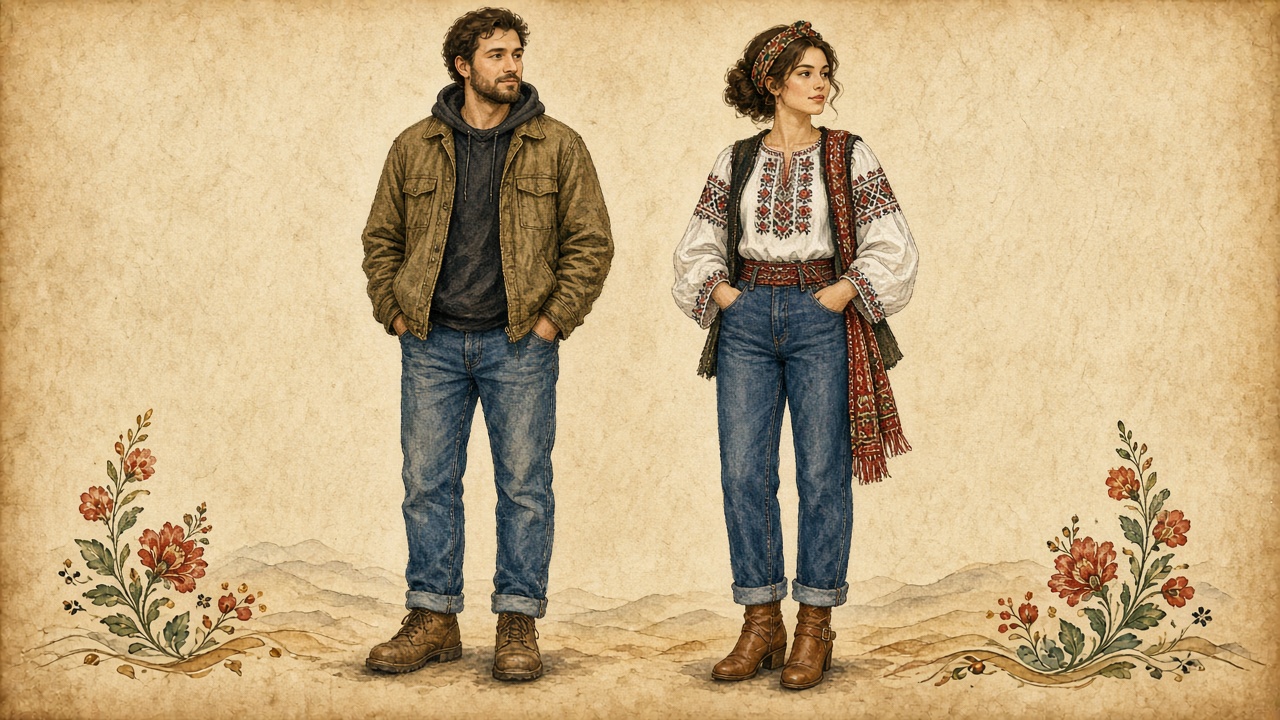
Everyday dress is a hooded jacket, jeans, and boots. The other figure wears the ia with those same jeans, a woven scarf, and boots. A wedding, a family Sunday, or a plain wish to put the blouse on: the mix is ordinary. The stitch is still the one on crafts. The apron and the fur hat can stay in the older plates. The shirt comes out with jeans.
Shop clothes do the week. The cupboard may still hold a blouse someone embroidered, or one bought because the sleeve looked like a grandmother’s. The dated stop is on the timeline. Both sides of the pair can wear jeans. One side still carries the old shirt.
How to read these plates
Each drawing sets two garments side by side so the split is easy to see: work, and rank or the city. The lines are schematic. They are not lifted from one grave, one museum case, or one village. A sleeve from Maramureș and a sleeve from Oltenia are different stitches. A boyar in Iași and a boyar in Bucharest did not share a tailor. The plate picks one working cut and one cut of rank or city fashion, and stops.
The captions stay short for that reason. Years — the province, 1859, 1918, the decades after 1965 — sit on the timeline, where the same six images hang under dated stops. Men and women name a few people on the court side of these centuries. The house is where the working cloth was washed, hung, and sewn. This page is the wardrobe: what the body had on when the work started, and what it had on when rank or the city asked to be seen.