
Constanța
A Greek town, a Roman exile, a port, and Romania’s window on the Black Sea.
Constanța sits on a low coast where the Dobruja meets the Black Sea. It is the country’s main seaport. The name people used for most of its ancient life was Tomis. Greek settlers from Miletus put a town here in the sixth century before the common era, one of a string of colonies along this shore. The sea was the street. Grain, fish, and later the traffic of empires moved through a harbor that is still the reason the city matters.
The story almost everyone is told first is Ovid’s. The Roman poet was sent here in exile in the year 8, under Augustus, and he spent the rest of his life writing about the place as a cold edge of the world. That is a poet’s weather, not a climate report. Tomis was a real Greek and then Roman city, with a mosaic building whose floor you can still visit, aqueducts, and the usual mix of local and imperial cults. Ovid’s complaint made the town famous in Latin literature. It did not make it a ruin. The city went on being a port after he died.
The centuries after Rome put Constanța under Byzantine, Bulgarian, and then Genoese hands, and for a long time under the Ottomans, who knew it as Köstence. It was a lesser harbor than it is now, in a province, Dobruja, that changed rulers more than once. The modern Romanian city begins in 1878, when the Treaty of Berlin, after the war with the Ottomans, gave northern Dobruja to Romania. A young state that had been inland now had a coast. The port was built out, a rail line tied it to Bucharest, and the sea stopped being someone else’s.
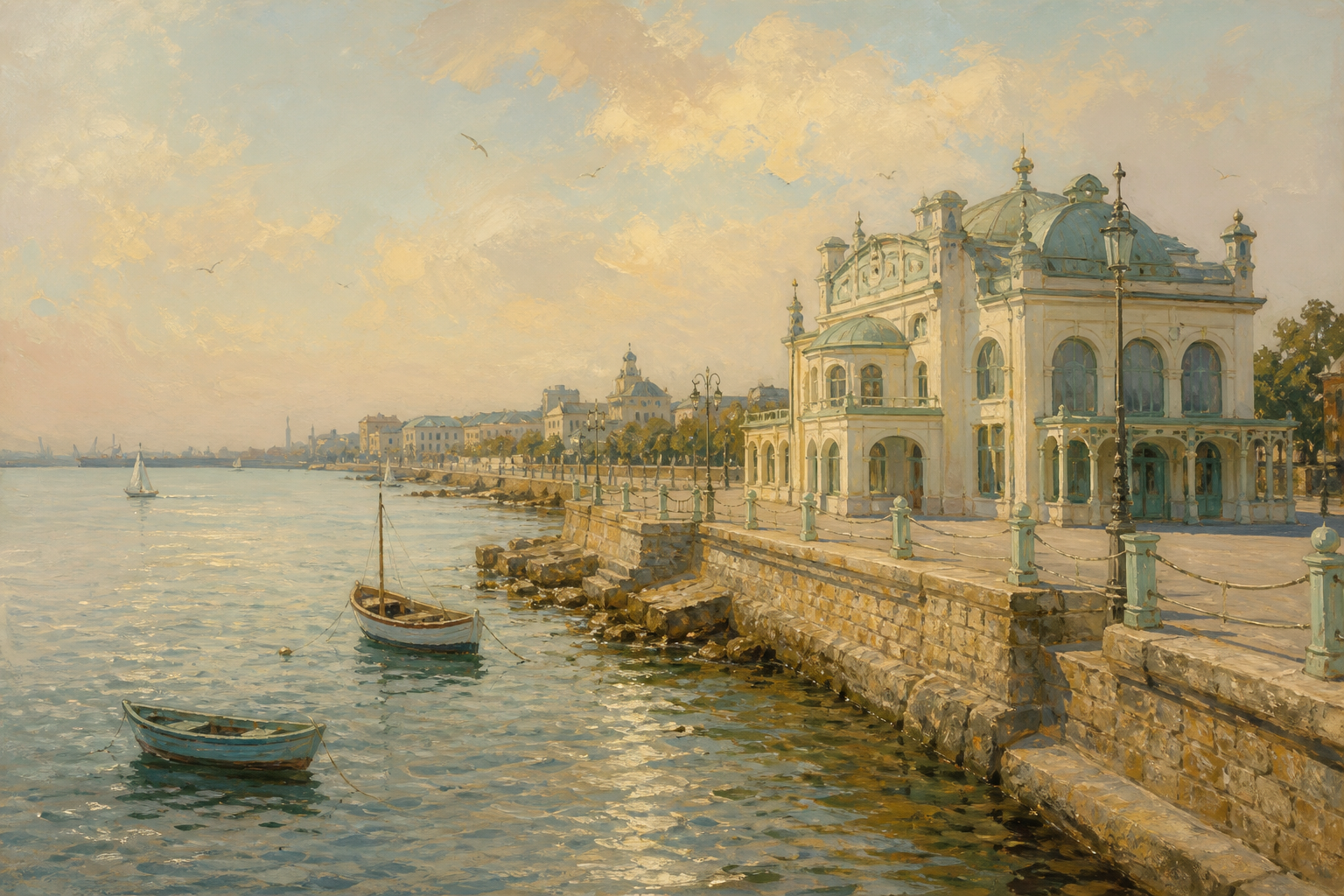
The building people mean when they say “the casino” is not a gambling story first. It is an Art Nouveau pavilion on a terrace over the water, begun in the first years of the twentieth century, used as a casino, a hospital, and a ruin, and repaired more than once. The picture on this page is imagined from that idea: a pale pavilion, a wall, boats. It is not a record of the restoration, and it is not a map of the working port, which lies to the south and is larger, louder, and more important to the country’s trade than the promenade.
North of the city, Mamaia is the long beach spit. South, the coast runs toward Mangalia and the older Greek name Callatis. Inland, the Dobruja is a dry, windy steppe with a different history from the mountains: Tatars, Turks, Lipovans, Aromanians, and others have lived here in numbers that a single “Romanian coast” story leaves out. Constanța the city is majority Romanian now. The port is national. The older town underneath it is Greek, Roman, Ottoman, and only lately the seaside of a Bucharest-centered state.
If you are reading the rest of these lessons, Constanța is the place where several of them touch. Tomis was a Greek city in a Thracian-facing sea. It was a Roman city when Dacia was a province and after. It became Romanian in the same generation as independence. The flag on this site is the later country’s. The harbor is older than the flag.