

The well
Fântână. In a village yard it can be the first thing you hear in the morning: the creak of the wheel, the bucket hitting water, a chain that has learned one path down and one path up.
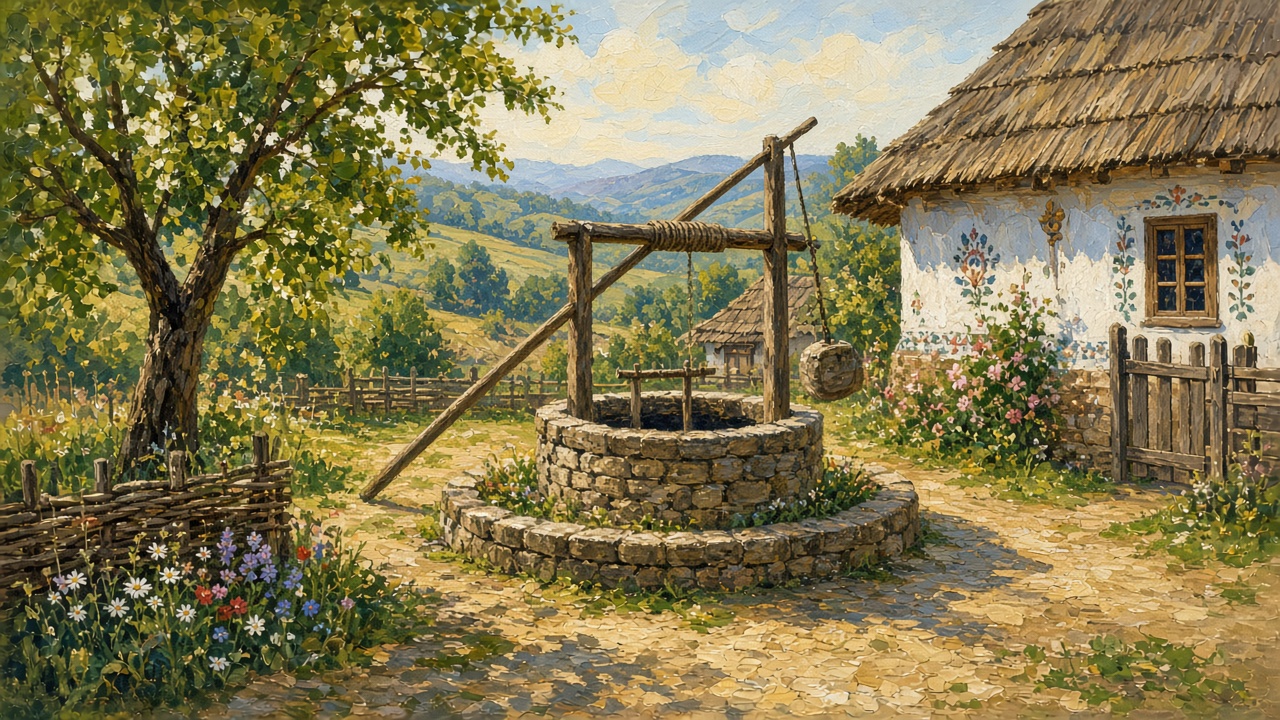
In the yard
Many older houses keep a well inside the fence, near the summer kitchen or the vegetable beds. A wooden or concrete collar, a roof of boards against rain and leaves, a wheel and a rope or a crank. You lean over and smell cool earth before you smell the water. Children are told not to play there and then they play there anyway, dropping pebbles to hear the splash. The dog knows the spot. So does everyone who comes to borrow a cup of water when their own pump fails.
Drawing water was work. Two buckets on a yoke across the shoulders, or one heavy can carried with both hands. Clothes washed in a tub beside it. A splash for the chickens. In winter the rim ices and someone breaks a crust with a stick before the first draw. The house page maps the yard this sits in; the well is the cold center of that map — see the house.
The shared corner
Not every house had its own. A pump or a deeper well at the street corner served a row of gates. People met there with cans and gossip. You waited your turn. You heard whose roof leaked and whose son was leaving for the city. The spout had a particular taste of iron. On hot afternoons the line grew longer and the talk slower. When piped water arrived in a village, some of those corner wells stayed as landmarks and as backup — and as a place to lean when you had nothing urgent to carry.
Blessing and story
Water from a well shows up in blessings and in ordinary talk. A priest may bless a new well the way a house is blessed. Folklore fills wells with wishes, with warnings about falling in, with the idea that the clearest water sits farthest from the road. None of that replaces the practical fact: before the pipe, the well decided how far you walked before coffee, how clean the floor stayed, and whether a garden lived through August.
What changed
In a lot of yards the well is capped now. A lid, a padlock, or a concrete plug, and the tap indoors does the daily work. Some families still keep the old wheel as ornament. Some still draw when the pressure drops or when they want water that tastes like the ground they know. In apartment blocks there is no well at all — only the stair and the meter — and the memory of one sits in stories grandparents tell about mornings that started with a chain.
Market day still meant loading what the garden grew; the well was how that garden drank. The rhythm of seasons around all of this lives on the year page. This page is only the water point: collar, rope, cold air, and the habit of checking the level before you trust the day.