
Șezătoare
Șezătoare. An evening in a village room when spinning and sewing are done together, with talk and a song sitting beside the work. Not a party. Not a class. Company that had a job in its lap.
The room, not the hall
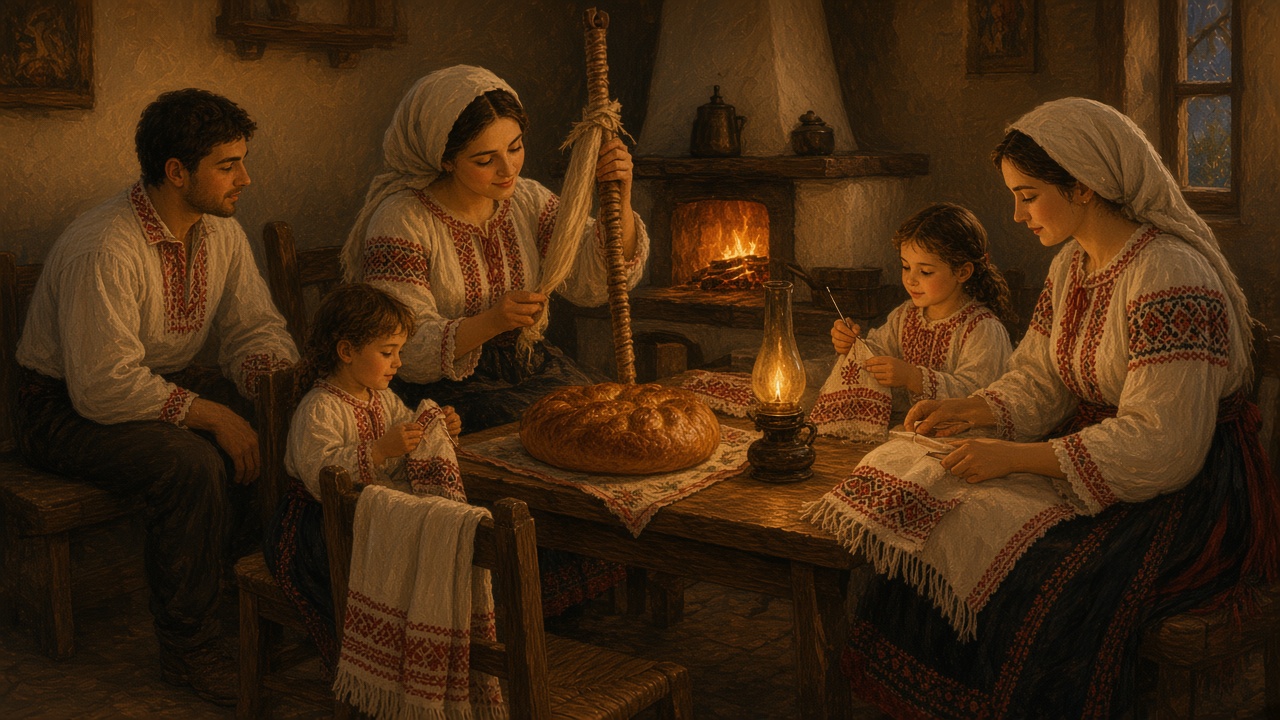
A șezătoare is an evening of work in someone’s house — often the room by the stove, the one mapped on the house. You sit. You bring what your hands already know. Neighbors come because the lamp is on and the wool will not spin itself. Nobody stands at the front. It is not a concert and it is not school. The point is that the evening is long, so you do the work where there is talk.
The word sits in the village the way a well or a gate does: ordinary, named, and easy to miss if you only look for feasts. A nuntă fills a yard; that day is on wedding. A șezătoare fills a room and then it is over, and the yarn is longer than it was.
Who sits there
Women and girls, mostly. A mother, a neighbor, a girl old enough to hold a needle without being told twice. Sometimes another household from down the lane. The ordinary work of the house — cloth, feast, the year through women’s hands — is also on women. Young men stop at the door or take the bench by the wall. They are not the workers. They talk, they listen, they wait to walk someone home. That watching, and the older courtship at the poartă, live on romance. The șezătoare is the indoor version: the same village looking, only with work in the lap. A child in the same room may only hold a scrap of cloth, or slip out to the yard; that outdoor list is on games.
What the hands do
Spinning, first. Wool or flax, a caier of fiber on the furcă — the distaff — drawn down onto the spindle, the fuior thinning as it twists. Embroidery on a sleeve or a ștergar. Mending that would be dull alone. Some of that stitch was once a pile a girl was expected to have before a nuntă — the day is on wedding. The pressure is gone in most towns. The evening is not. The stitches and the loom have their own page, crafts. This page is the evening those stitches used to share: the same work, only not solitary. Talk sits beside it. A song starts and nobody puts the work down. Dor can live in a line someone hums without making the night a concert; the named music of a taraf and a hora is on music. The hora that clears a yard is a different night. That floor is on dance.
What is said
News of a house, a price at the market, a girl who will marry in the spring. The older sentences — the ones that sound like a proverb — turn up here because someone has already lived them; those sit on proverbs. A story told with the work still in the lap is not the short practice pieces on stories, but it is the same habit: words with company. Nobody stands at the front. The talk is the point of sitting together, and the yarn is still longer when the lamp goes low.
When the yard slows
The șezătoare belongs to the indoor months. After harvest the fields ask less; after the first frost the yard asks for wood, not weeding. Autumn and winter evenings are long. That weather, the stove, the woodpile, is on winter. The house holds the gathering because the road does not. Colinde nights are a different knock — carolers at the door, a glass, a verse — and that visit is on colinde. A șezătoare does not walk the street. It stays in the room until the lamp is low.
What still means
Many villages no longer keep a weekly șezătoare. The television, the commute, the empty houses from October to spring — the same facts already on the villages page — took the habit. Some places still gather for a craft evening or a remembered night. The word remains. Grandmothers still say it the way they say the well or the stove: a room that used to fill, and a kind of company that was not a feast. This page is only that evening: the furcă, the talk, the bench at the door, and the memory that still answers to the name.