Music and dance
What a wedding still sounds like, and a few instruments with their own names. Not a complete map. The tune changes when you cross the mountains.
The instruments people mean
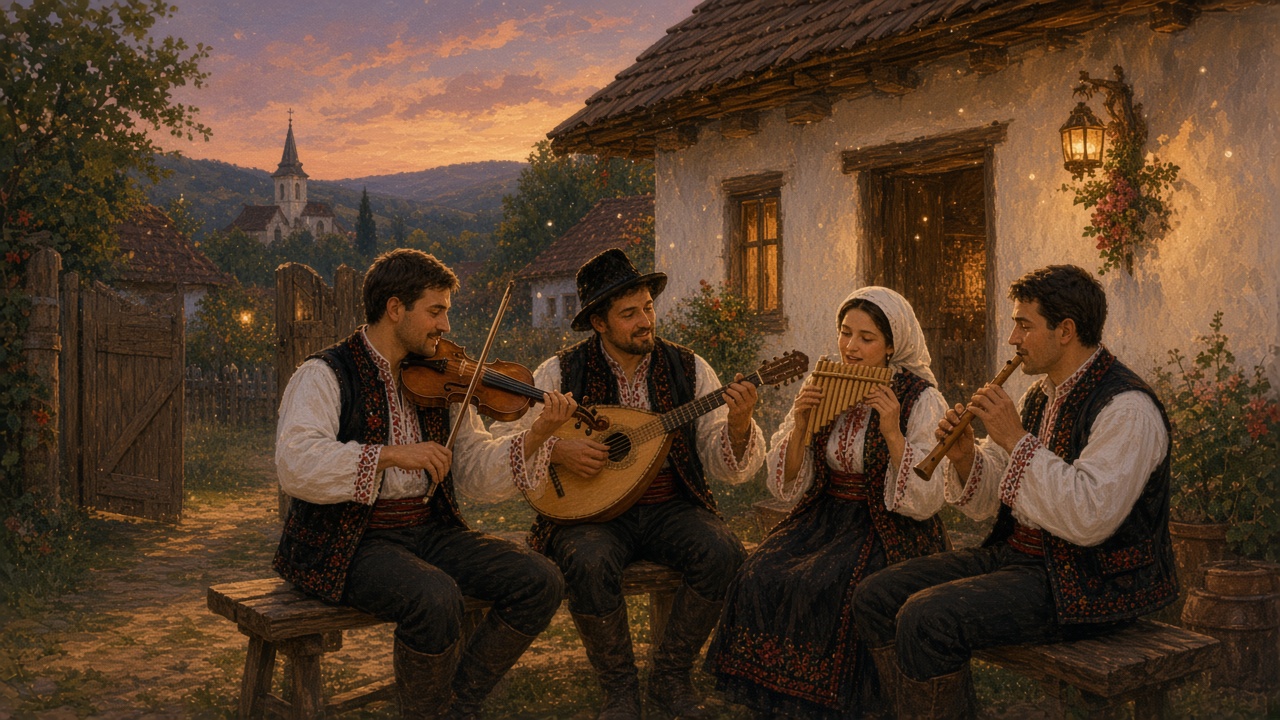
The nai is the pan flute: a row of pipes, shortest to longest, bound in a slight curve, played by blowing across the open ends. A shepherd’s nai was a smaller, less even instrument. The one on a record is usually the concert nai, built out in the twentieth century so it could follow a violin anywhere. Fănică Luca taught that modern instrument. Gheorghe Zamfir is the player most people outside the country have heard. Beautiful, and a little apart from the yard. You will still hear a nai in a band, but it is no longer the ordinary voice of a village afternoon.
The fluier is the ordinary flute. Wood, a few finger holes, end-blown. There is a small one and a long one. A tilincă has no holes at all and works on the overtones, but if someone says fluier they usually mean the holed one a person can make and carry in a coat. It is still the instrument of the sheepfold, and it still starts a dance when nothing bigger is at hand.
The cobză is a short lute: a round-backed body, a short neck, strings in courses, used for chords and a hard rhythmic stroke more than for the tune. In a taraf, the small band that plays the wedding, it sits under the violin. A guitar has taken that chair in a lot of living bands. Where the cobză remains, you hear the difference. Drier, less padded, and closer to the beat the feet need.
The cimpoi is the bagpipe. A skin, usually a goat’s, a chanter with holes, and often a drone beside it. Players call the chanter the carabă and the drone the bâzoi. It is loud enough for a yard without a whole band. The living tradition is strongest in Moldavia, and the instrument is not built the same way in every county, so one national bagpipe is already one instrument too few. It plays dance tunes. It does not play the slow song.
Sheepfold and table
The fluier still belongs to the stână more than to a stage — that hill is on shepherds. A cobză or a violin belongs to a table that has been cleared. The concert nai belongs to a record. Those three places are not the same music, even when they share a tune. One is a tool you carry in a coat. One is a band you hire and feed. One you can buy without ever seeing the yard.
The dances a guest can see
The hora is the circle dance. Hands joined, a closed ring or one that has not quite closed, the step simple enough that someone who has watched for a minute can take a place. It can begin almost at a walk and pick up. At a wedding this is the dance the whole table can enter: children, the couple’s parents, a neighbor who does not think of himself as a dancer. There are many horas, named by village or by tune. Hora Unirii is the one learned in school, a song written in the years of the union of the principalities, not the same thing as the hora that starts when the band comes back from a break. The floor itself — who takes a place, the yard, the circle that is not a stage — is on dance.
The sârba is faster. The line or the circle runs, the step snaps, and the men are more likely to stamp and lift. The name is the same word as Serbian, a label that stuck to a Romanian dance family the way other tunes here are called ungurească or rusească. It marks a type, not a passport. If the hora is how the yard says it is together, the sârba is how the same yard gets warm. They often sit in the same evening, the slower circle first.
The călușari are different, and not a dance you join. They are a company of men who dance at Rusalii, the week of Pentecost, above all in Oltenia and Muntenia, and also in parts of Transylvania. The group has a leader, the vătaf, and often a mute who is allowed to break the seriousness. The steps are high and hard: leaps, stamps, and in many villages a stick. Spurs or small bells on the heels keep the time. For those days the company is bound to its own rules, and it goes from yard to yard rather than waiting for a wedding to hire it. People in the villages that keep the rite have long said it had to do with health, and with the spirits of that season. That explanation belongs to them. What you can say from the road is narrower. This is a men’s ritual dance, athletic and ordered, not a hora with costumes. It is on UNESCO’s list of intangible heritage, which is a filing fact, not a reason to treat the dancers as a show.
The song that is not a dance
The doină is a slow sung lament, and also the same kind of melody played on a fluier or a nai. The rhythm is free. The singer takes the time a sentence takes, and then more, and ornaments the line until it almost stops. The subject is longing, a person who left, the army, the road, or simply dor, that ache for someone or somewhere not here. A doină can open an evening, before anyone stands up. It is not in the circle. When the band wants feet, it leaves the doină and goes to a hora or a sârba. How that word sat in courtship, not only in song, is on romance.
What most people actually hear, if they hear this music at all, is a taraf at a wedding or a Sunday dance: violin in front, accordion, a țambal, a bass, and sometimes a cobză, a clarinet, or a nai. That is the southern and Moldavian picture, and it is already too tidy. Across the mountains the night is often a pair of violins and a bass, and the couple dance, the învârtita, the turning, matters as much as any circle. The instruments above are the ones with names a visitor is likely to be told. They are not a national orchestra. They are what the hands still pick up when the table is cleared and someone has to start. December has another sung visit that is not a dance: colinde, the carols that walk to the door.