
Colinde
Not a concert. The carols that still walk to the door in the dark week around Crăciun, and the house that opens for them.
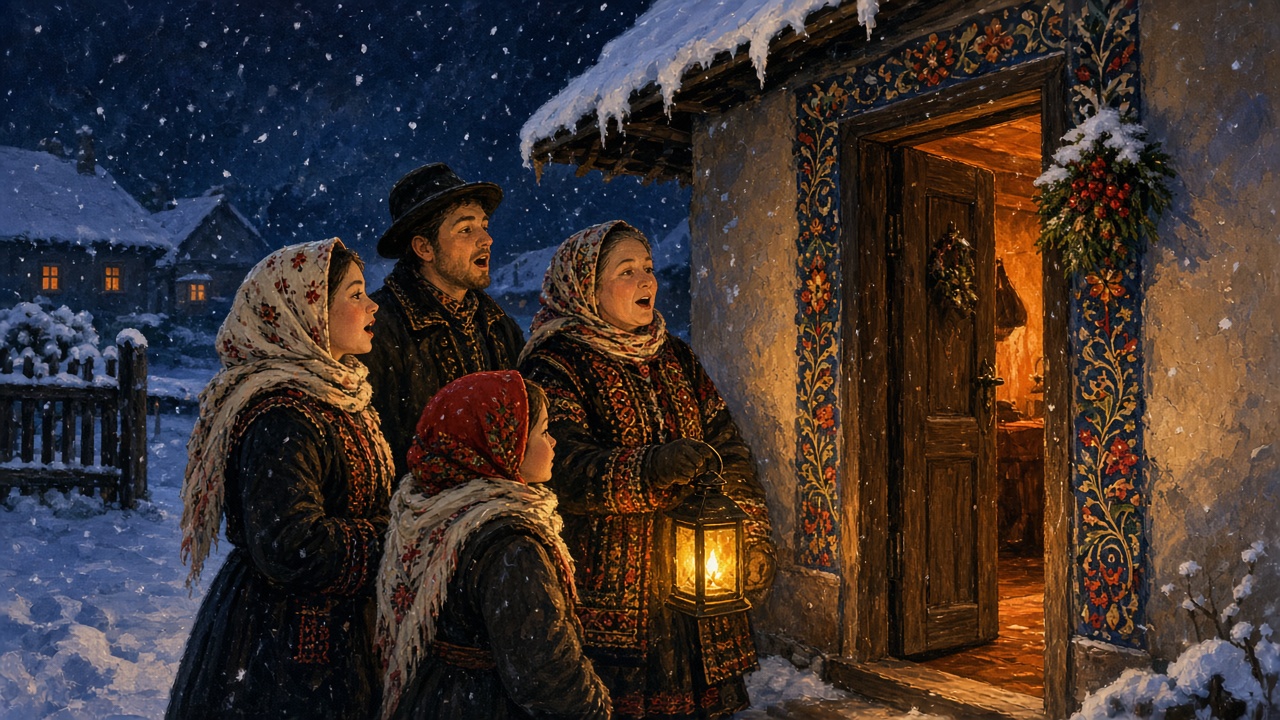
House to house
Colindători stop at the gate or the door and sing. They stand at the poartă first — that threshold, in the north, is on gates. The household that still keeps the custom does not leave them on the step. A glass, a piece of cake or a colac, coins, nuts, an apple — whatever the table can spare after the fast. A pour if the house has it — wine or the stronger glass — sits on wine and țuică; the visit is the song, not the drink. Children come in a small pack, a parent a few yards behind. In some villages a company of young men still walks the street as a set that knows which yards will open. Town blocks hear less of this. How a sat still opens a yard is on villages. The year page already said the true thing: they still walk some streets.
Steaua, and the plough
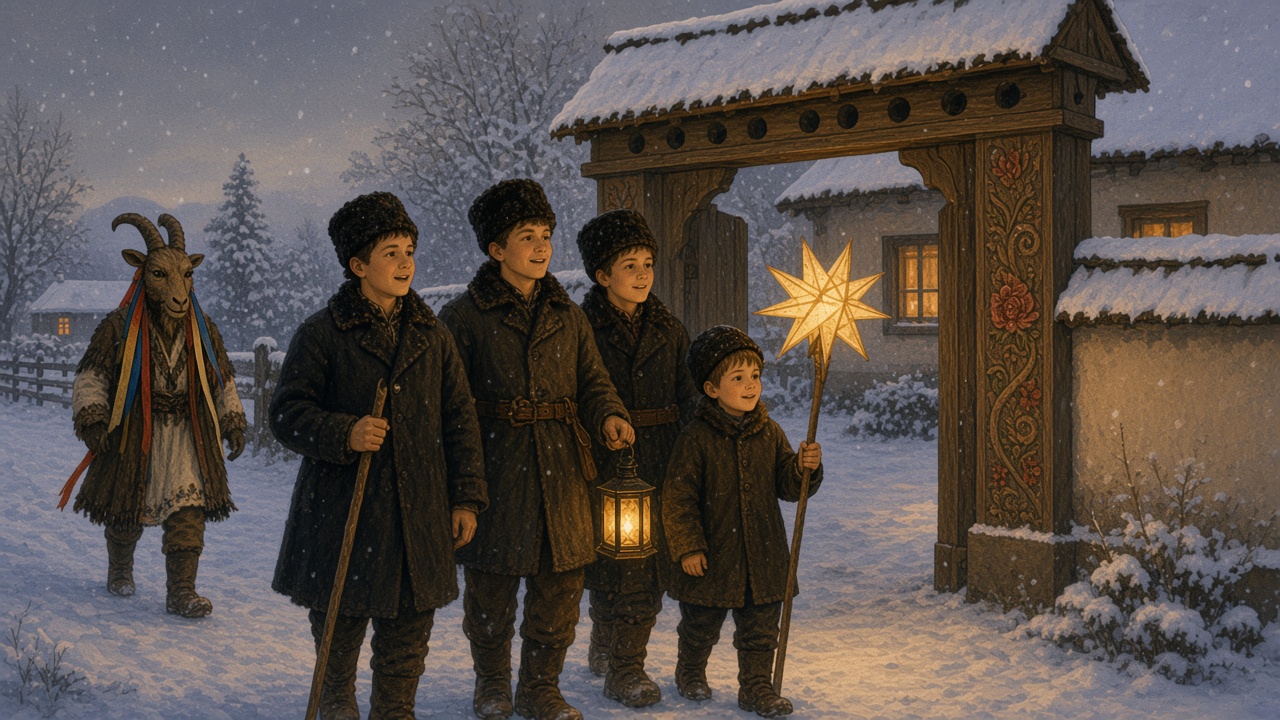
A few visits have names. Steaua is the children’s one: a paper or foil star on a stick — the Star of Bethlehem — and a short carol about it. You hear it in stairwells as much as in yards. Around New Year, Sfântul Vasile, some places keep Plugul, the plough carol: a small plough, or the words of one, and a wish for the house and the field. Sorcova and other New Year wishes walk some streets too; this page does not catalog them. It only names the two a guest is likely to be told. That date sits on winter on the year. Children who still play in the yard that week find the same packed snow as always — that cold is on winter; the games are on games.
The table that opens
Christmas ends the Nativity fast. The table that has been holding back meat opens again: pork if a pig was killed for Ignat, cabbage, cozonac if the dough rose, and what autumn put in jars. The colac on that table is a bread with a job — the weekday loaf is on bread. What autumn put away is on harvest. Ignat’s pig, if the yard still keeps one, is the animal half of the same winter shelf — that day is on winter. Carolers arrive into that, not into a concert hall. The room that holds the table is on the house. The feast dates are on the year. The knock is this page.
Ajunul
The night people mean is Ajunul — the evening before Crăciun, on the date the parish keeps. The year already set the common reckoning on the twenty-fifth. Some houses still keep the older calendar. That difference sits on Orthodoxy. This page does not pick a civil date. It names the evening. The fast is still the kitchen’s rule. The opened table is Crăciun, already above. On Ajun the house is waiting, and the lane is dark enough for a lantern.
Colindători come after dusk, not at breakfast. Children, a parent a few yards behind. A ceată that has the verse already learned. The first stop is the poartă. What the house hands through was named with the visit — a colac, nuts, an apple, a few coins, set out before dark because the knock is expected. The cold on that walk is winter. The knock is this night.
The ceată, and the vătaf
Where young men still walk as a set, the set has a name: a ceată. They are not a choir that booked a hall. They learned the verses in someone’s kitchen. They know the order of the yards, and they keep to it. The man at the front is often the vătaf. He starts the song, he speaks for the band, and the houses’ gifts stay with the ceată until the street is done. Not every sat uses that word. Some have another title for the same job. The same word names the leader of the călușari, on music — another company of men, another season. The fact here is the leader, and a band that does not split up between houses.
The road does not look the same in every valley. In Maramureș a colindă can run long — a story sung at the gate, not a short verse for a stairwell. That wood is on North. In other lanes, in the days around the New Year, a mask walks with the songs or instead of them. The capra is a goat with a clacking jaw. The ursul is a bear, and the man who leads it. That is a play in the street. It is not the verse at the door, and it is not every county. Steaua, the paper star, is still the children’s visit this page already named. You do not need a map of costumes. You need the habit of asking which street still has a ceată, and whether the thing at the gate is a song, a star, or a mask.
Church night, street night
The liturgy is one singing. The door is another. Belief, the Nativity fast, and why Christmas may not fall on the Western date sit on Orthodoxy. The music page is the hora, the sârba, and the doină — wedding and Sunday sound. Colinde are not those. They are a visit. A troiță on the approach holds snow while they walk past; they do not sing to the cross. Paște is the other night that still fills a church — a candle, not a carol. School concerts and television made a stage version; apartment intercoms made a quieter street. Some houses still wait for the knock. On Ajunul, if the street still has one, that knock is a ceată. You do not need a catalog of verses. You need the habit of asking whether this street still opens, or only plays a recording from the kitchen.