
Traditions and craft
What the hands still make. Quilting is here, and so are the older textile and wood trades around it.
The blouse, the towel, the cover
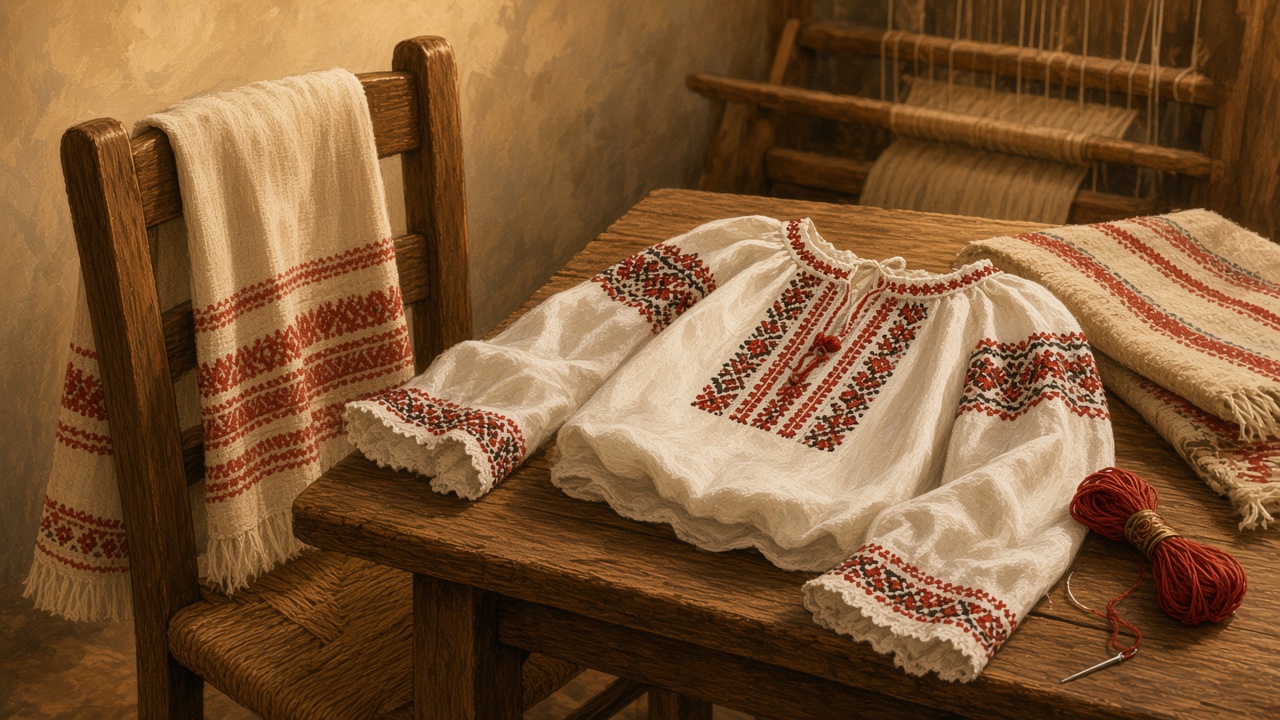
The ia is the embroidered blouse. The stitch, the sleeve, and the color mark a region more reliably than a postcard. A ștergar is a woven or embroidered towel, hung on an icon corner or offered to a guest. A cuvertură is a coverlet for the bed. Some of these are woven in one piece. Some are pieced from older cloth, which is the nearest thing in the house to what English calls a quilt. Romanian villages did not build the American block-quilt tradition. They did piece, patch, and layer wool and hemp covers against winter. If you are looking for quilting, start with the bed cover and the rag rug, not with a shop pattern. Imagined plates of the ia next to court and city dress sit on wardrobe and on the dated stops of the timeline.
Making
Embroidery is the craft most people can still name. Cross stitch, a flat satin stitch, and a hem stitch on the cuff. The cloth is cotton or, older, hemp. Red and black are the colors people remember. Yellow, blue, and a little green appear by region. A girl was once expected to have a pile of this work before marriage. That pressure is gone in most towns. The stitch is not. A ștergar from that pile still turns up at a nuntă; the day itself is on wedding. The courtship that used to wait on that pile is on romance. A lot of that stitch used to happen in company, at a șezătoare, not only at a solitary lamp.
Weaving sits beside it. A narrow loom in a back room, wool or cotton, stripes and a small geometric pick. The same hands that embroider a sleeve may weave the towel that hangs over the icon. A scoarță on the wall, a rag rug on the boards — those are the pieces that wear first, and the ones a guest actually steps on. Pottery, especially the Horezu style from the hills of Vâlcea, is a different workshop. Spirals, a rooster, a green or brown glaze. Wood is the Maramureș gate and the church roof. Those are craft too, though they are architecture by the time they stand in a yard. See wooden churches for the tall shingle roofs that make that craft a skyline.
Wood that is not a church
A spoon, a dough trough, a chest with a painted lid. The same timber trade that raises a Maramureș roof also fills the kitchen. The farmyard poartă — rope motifs, a sun disk — sits on gates. What belongs here is the smaller work: a carved distaff for the evening on șezătoare, a painted box for the dowry cloth, a chair that was never bought. Those pieces live in the house until they split, and then they are firewood.
Eggs and the year
Before Easter, eggs are dyed and, in Bucovina especially, drawn with wax so a pattern stays pale on a dark shell. That is încondeiere. It is seasonal. You do not see it in August unless someone is teaching it. The feast that wants those eggs is Paște. The rest of the year the craft in the house is cloth and, in some villages, clay.
What this site is not selling
The store tab is still a table, not a workshop. These notes are so the pictures of cloth and wood have a name. If a real piece is added later, it should say who made it and where the stitch comes from. Until then this is the map of the handwork, not a catalog of stock.
The bed cover and the icon towel sit in a real room. See the house for the yard, the stove, and where that cloth hangs. Some of that cloth still reaches a buyer at the market.