Dance
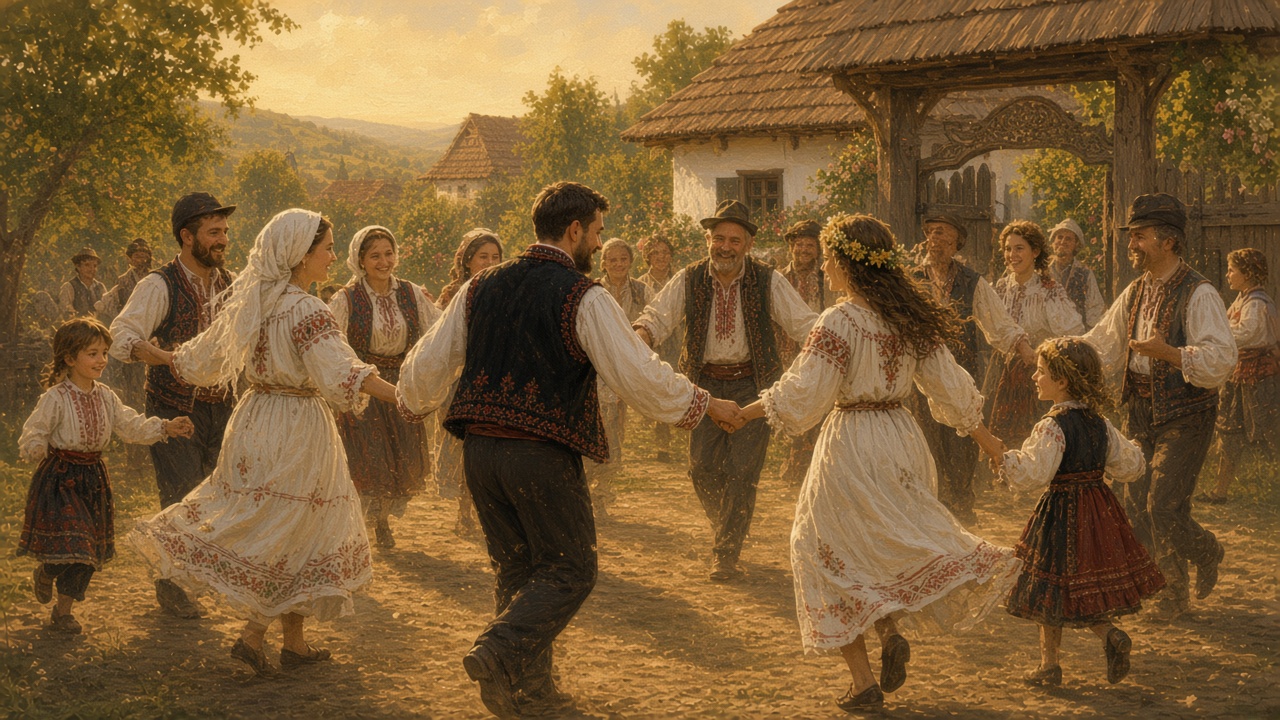
Hora. The circle the whole room can enter — hands already joined, a wedding yard or a feast, before anyone has decided they can dance. Not a stage. Not a list of steps.
The circle
The hora is the dance people mean when they say the room stood up. Hands joined. A closed ring, or one that has not quite closed. The step is small enough that someone who has watched from a chair can take a place without a lesson. It can start almost at a walk. It can pull until the ring leans. There are horas named by village or by tune; this page does not list them. The fact is the same: the floor became a circle, and the circle took whoever would hold on.
Cousins, not a catalog
The sârba is faster. Same floor, a tighter count, men more likely to stamp. If the hora is how the yard says it is together, the sârba is how that yard gets warm. They often sit in the same evening, the slower circle first.
Across the mountains the couple matter as much as the ring: the învârtita, the turning, two people in a hold the circle does not use. A guest does not need every named dance. They need to know the hora will take a hand, the sârba will hurry the same boards, and the turn is a closer claim — fewer people, not the whole table.
Where the floor is
This happens where people already are. A nuntă in a yard or a hall — that day is on wedding. A name day, a Sunday, a feast that fills the road the way villages still fill. Chairs pushed back. Dust, a tent pole, the band in a corner that is not a stage. The cămin cultural has a speaker and a patch of boards. None of this is a costume recital. You watch a show from a seat. You enter a hora from wherever you were standing.
A șezătoare is a different evening: work in a lap, a song that does not stand the room up. That room is on șezătoare. Dance wants space and a reason to clear it.
Who holds on
Children at the edge, missing the step and staying in. Elders who still know the count when the young ones only know the song. People who only hold hands — they are in the hora as much as the ones who stamp. At a wedding the nași may start the first circle. A neighbor who does not think of himself as a dancer still knows when it has begun. You do not audition. You take a place, or you watch from a chair, and both are ordinary.
What people wear
On a Sunday the circle may be jeans and a shirt. At a nuntă some still put on the embroidered blouse, or a vest that came out of a cupboard for the day. The plates of that dress sit on wardrobe. You do not need the ia to hold a hand. The floor does not check. The stitch is another pride, not an entrance fee.
The sound is another page
What starts the feet — the taraf, the violin, a fluier when nothing bigger is at hand — lives on music. This page does not name the instruments again. The band is hired for the day. The circle is what the room does with that sound. The ritual company — the călușari at Rusalii — is a different floor: you watch, you do not join. That company stays on the music page.
What still means
Village nights are thinner. The weekly Sunday hora is rarer than the word. Houses empty from October to spring; that emptying is already on the villages page. A restaurant DJ still owes a hora or the room feels wrong. A wedding in town still clears a patch of floor. School still sings a hora that is not this one. The claim that remains is smaller and stubborn: when this company is together, someone will still join hands. This page is only that floor — the circle, the named cousins, the yard that is not a stage, and the word that outlasted the weekly night.