

Harvest
Recoltă, and for wheat seceriș. Not a festival poster. The weeks when the field finishes and the cellar starts to matter more than the porch.
Wheat and the sickle memory
Seceriș is the cutting of the grain. In living memory that meant bent backs, a sickle or a scythe, and neighbors who came for a day and were fed at noon under a tree. Combines do most of the work now where the fields are large enough, but the word stayed. People still say “am secerat” the way they say “we finished,” even when the machine did the finishing. Bundles, stacks, threshing on a hard floor — those pictures belong to grandparents more than to a teenager with a phone. What remains is the smell of cut straw, the hurry before rain, and the quiet after the last load leaves the plot. Flour from that grain is the loaf on bread.
Maize, vines, and the garden that does not wait
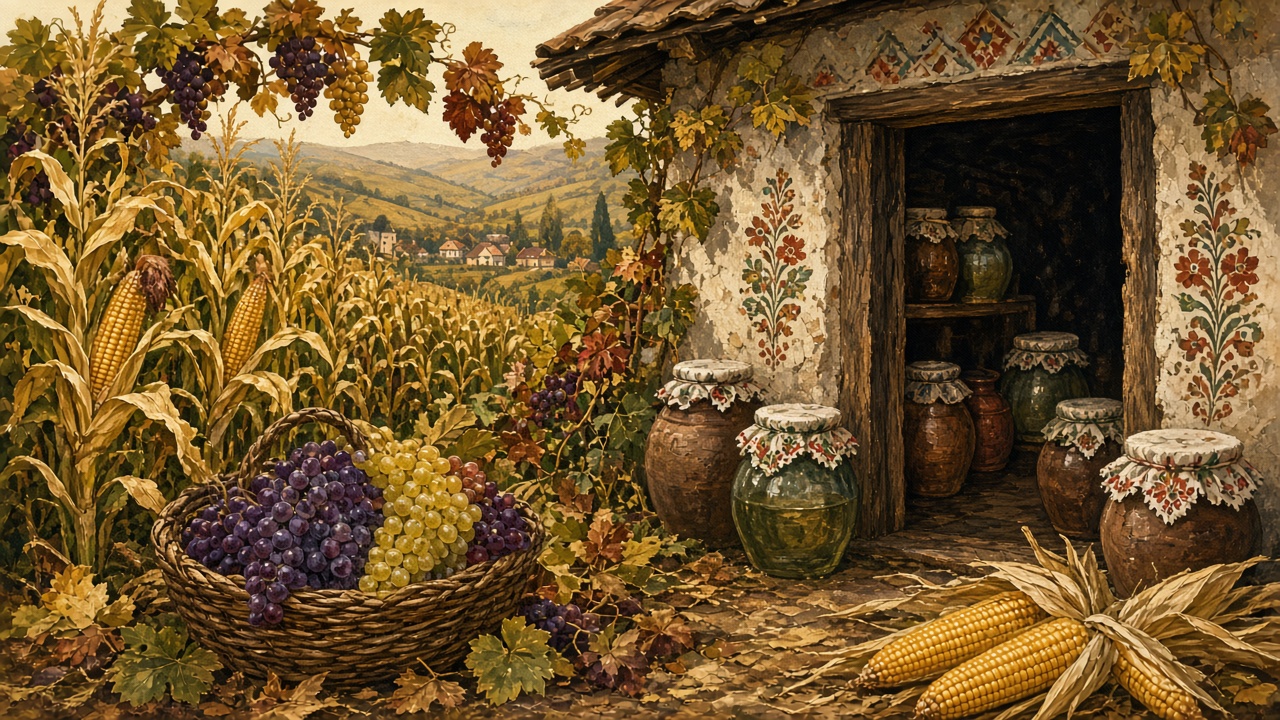
Maize (porumb) fills another kind of autumn: cobs stripped by hand on the porch, kernels dried for the mill or for the hens, leaves saved for wrapping. Grapes have their own calendar. Where the vines run, culesul viilor is a week of buckets, sticky hands, and juice that stains everything it touches. Some of it becomes must you drink while it is still sweet. Some becomes wine that will sit under the house until a name day or a funeral needs it — that glass sits on wine. After the plums, the stronger bottle is on țuică. The kitchen garden does not announce itself with a single verb. Peppers, tomatoes, beans, and cabbage leave the rows in shifts. What will not keep goes into jars — zacuscă, pickles, jam — until the shelves look like a second pantry and the house smells of vinegar, sugar, and the salt that keeps a barrel through the freeze. The recipes tab assumes that shelf exists; this page is how it got filled.
What the harvest still organizes
Market day after a good week is heavier. Carts and trunks carry onions in nets, apples in crates, cheese if the sheep were milked through the summer. The square on the market page is where surplus turns into cash or into someone else’s winter. Inside the yard, wood is stacked, the well is checked before the freeze, and the rooms that face north get the jars. Cloth work comes back under the lamp once the outdoor hurry slows — the year page marks that turn toward winter; see autumn on the year.
You do not need a national inventory of crops. You need the habit of asking what a household put away before the first hard frost. The answer is often shorter than an agricultural report: wheat or maize for the mill, grapes where the slope faces south, a jar of miere if someone kept bees — that page is honey — and jars that will still be opened at Easter when the garden is empty again.