
Gates
Porțile de lemn. In Maramureș the gate is not a fence door. It is a carved oak monument at the yard, tall enough to be seen from the next bend, and the first thing the road knows about the house.
Not a latch on a fence
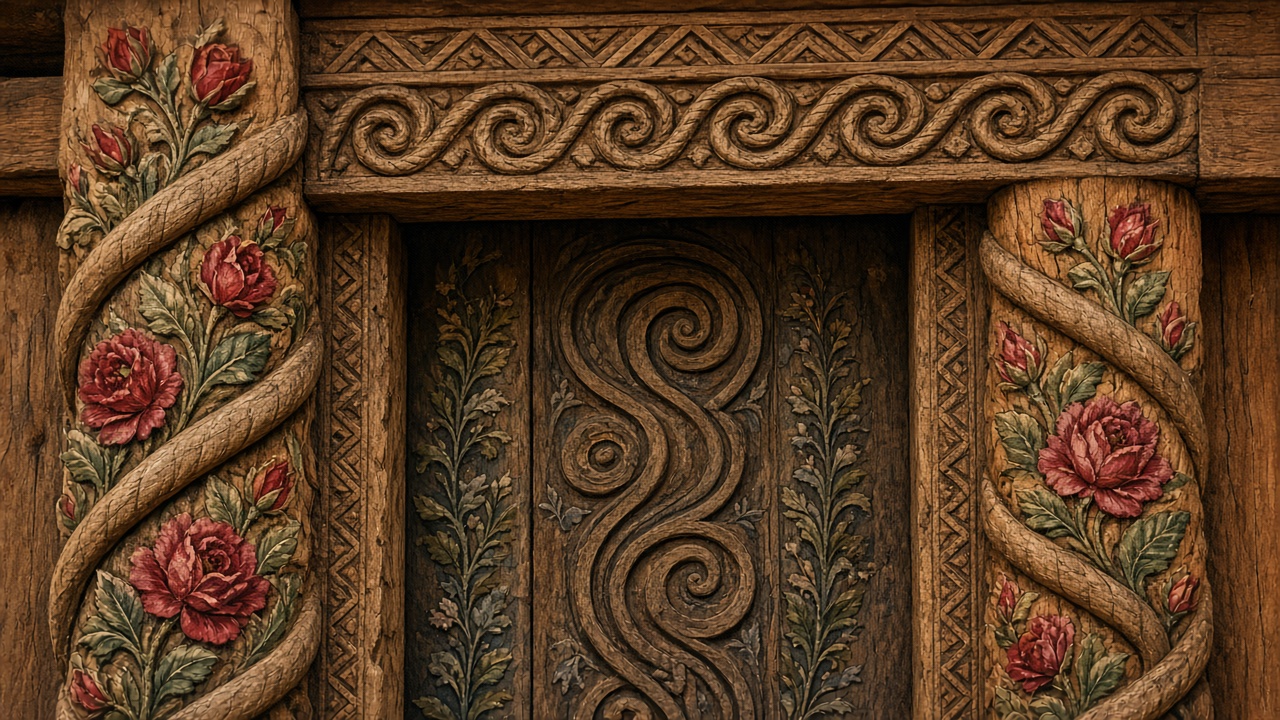
A poartă maramureșeană stands at the entrance to a household yard. Two posts, a lintel, a small roof of șindrilă, and often a side door for people while the main span is wide enough for a cart. You walk under it. You do not squeeze through a gap in boards. The fence may be wattle, the house modest, the woodpile ordinary — and the gate still claims the road. Porțile Maramureșului are the famous ones. Related northern wood traditions raise their own versions. The type is the same: a threshold made to be looked at, not only locked.
What is cut into the oak
Oak, because it lasts and because it takes a chisel. Rope motifs twist up the posts. Suns, crosses, a tree of life, geometric bands stacked like a belt. A short inscription asking for blessing, or a year, or a name. None of this is a catalog you decode from a guidebook. It is the household speaking in public: we kept a carpenter, we had timber, this yard has a face. The same hands that notched a church roof might carve a neighbor’s gate. The work is slow. The statement is the height and the density of the cut, not a plaque.
Church, house, road
The skyline of a Maramureș sat is three woods: the church roof, the house, and the gate. The parish gate into the cemetery is the same family of craft, only scaled to the biserică — that roof line is on wooden churches. The farmhouse poartă belongs to the yard mapped on the house: well, woodpile, a bench under the eaves, the stove inside. The larger claim of the road is on villages. Between this yard and the next sat, a carved or painted troiță may still hold the fork. The north that holds these valleys is North. You see the gate first. Then the roof. Then you know which household you have reached.
People still walk under them
These are not only museum pieces. Children still cut through. A wedding still leaves the poartă open. A funeral still walks out under the lintel. New gates go up in oak, or in a cheaper wood that will not last as long, and some yards now have a metal span because it is faster. The old ones weather gray and still work. You duck under a carved sun on the way to the shop. You wait for a tractor. The dog still knows the threshold. A locked gate in winter may mean the family is away until Christmas, but the wood is still the face of the yard when they come back. Maramureș is walked. The porți are how you enter it.